Wolf Moon

I’d like to take you all on a little Santa Fe vacation today. Come sit on my porch. It’s a bit chilly, but we have a heater. Here, you can sit next to it.


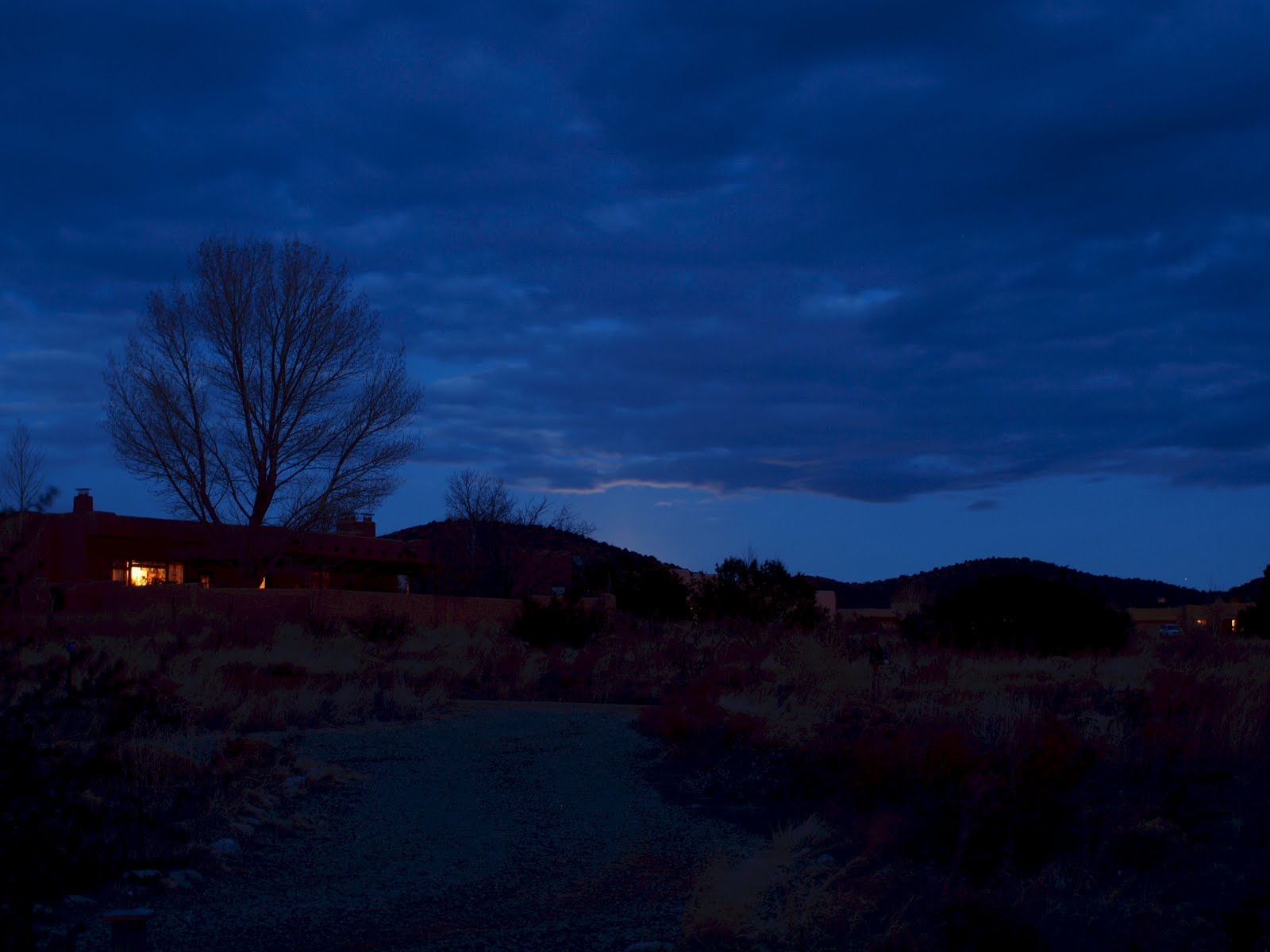
Sit with me and watch the full Wolf Moon rise.


I made sure to check the time and paid attention to where the moon rose the night before. Still, at first I wondered if I had it right. Then the sky began to lighten with that silver blue light that can be only moon.

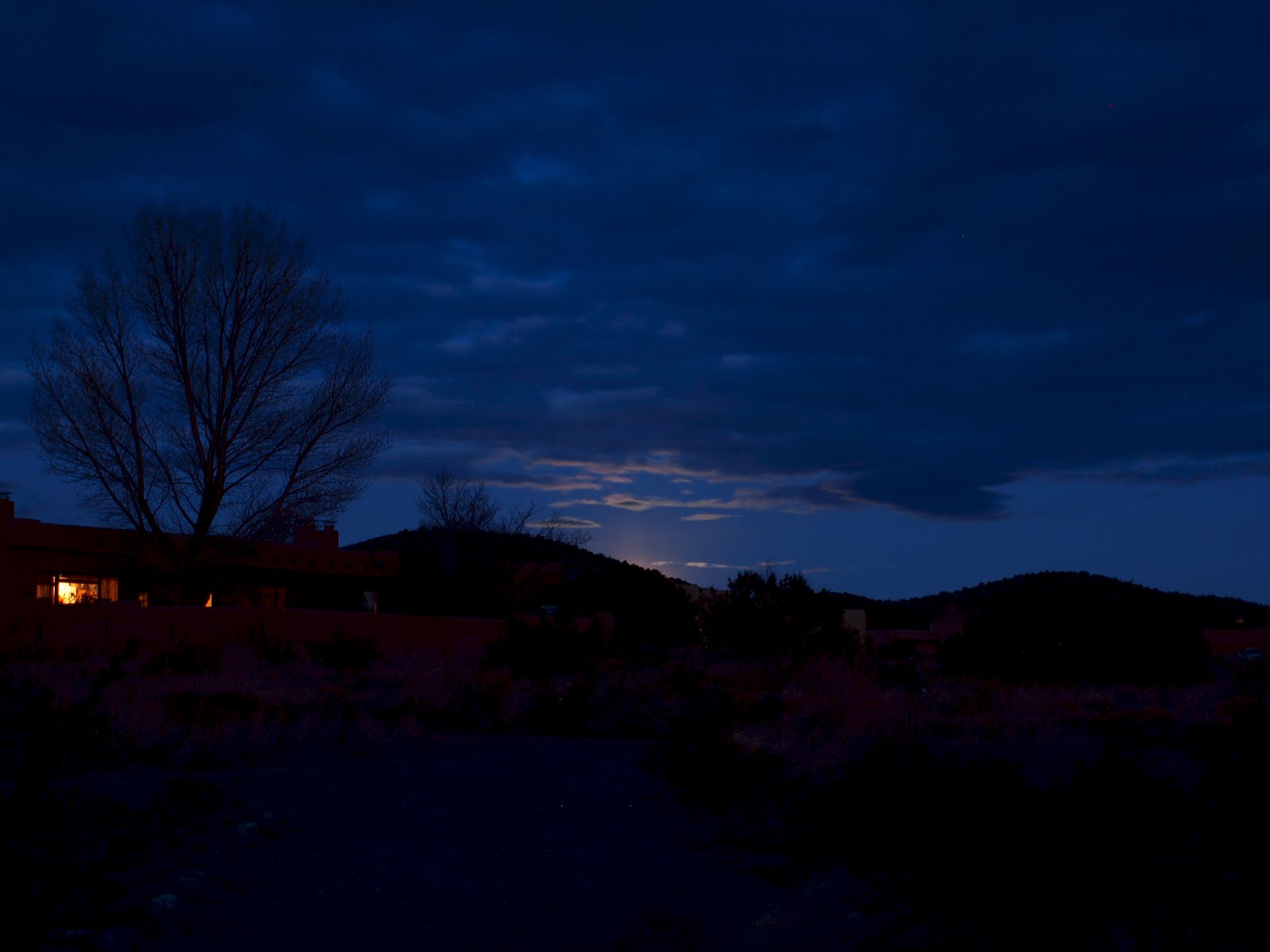
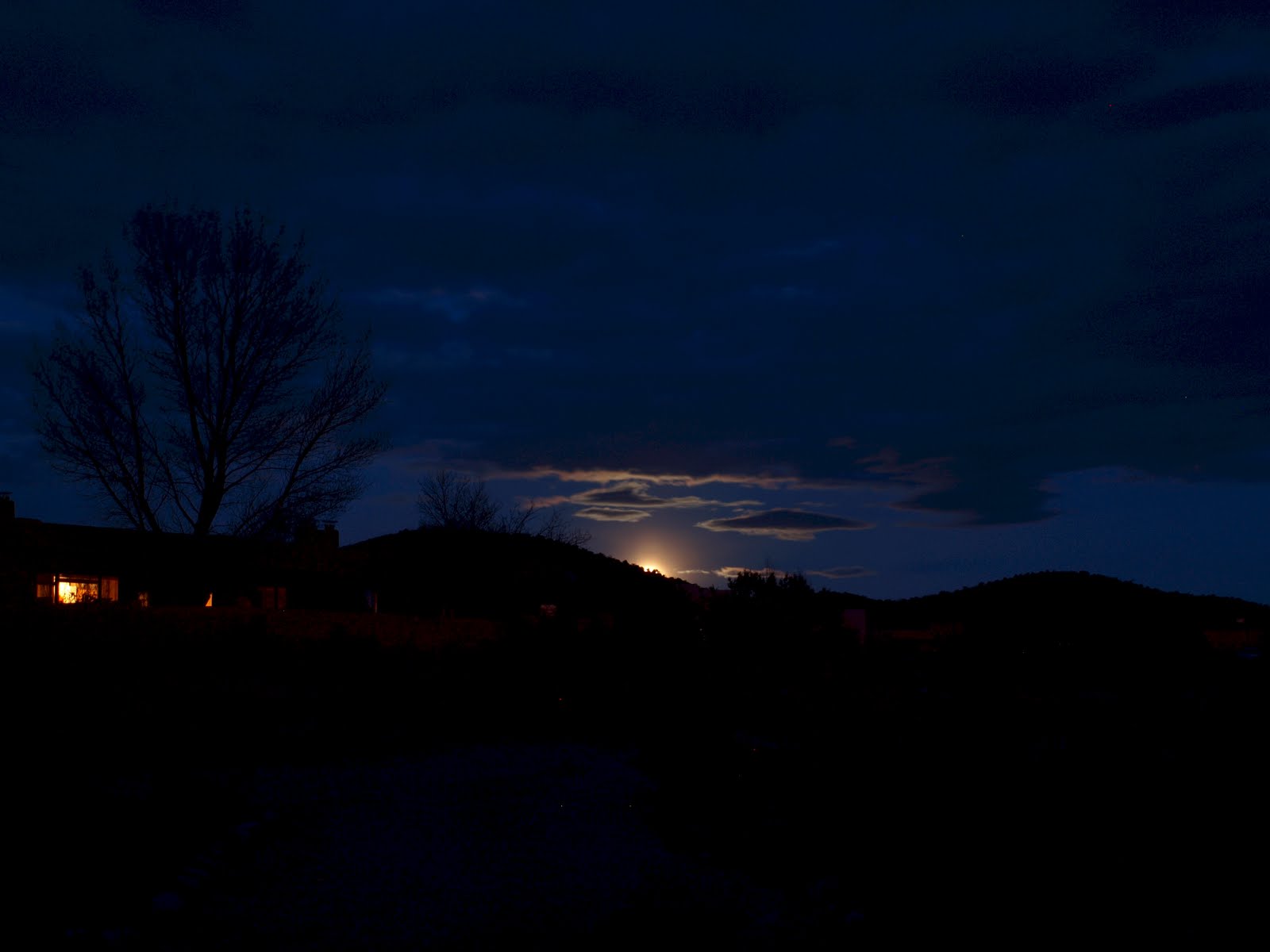
Finally a sliver of moon peeked above the hillside.

This part seems to happen so much more quickly. Even though I know in my head that we are turning faster than it’s moving, it still seems like the moon hurries.

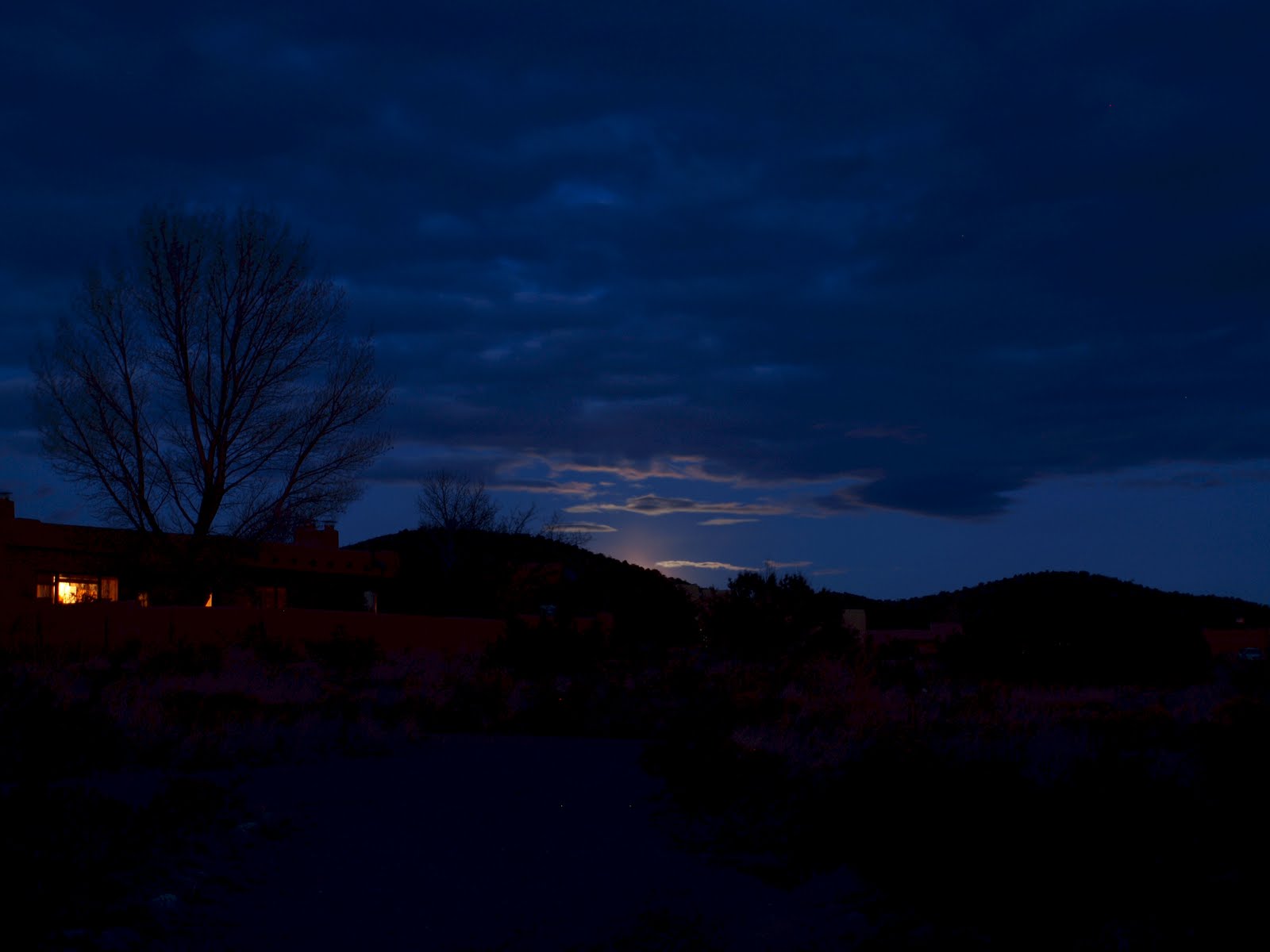
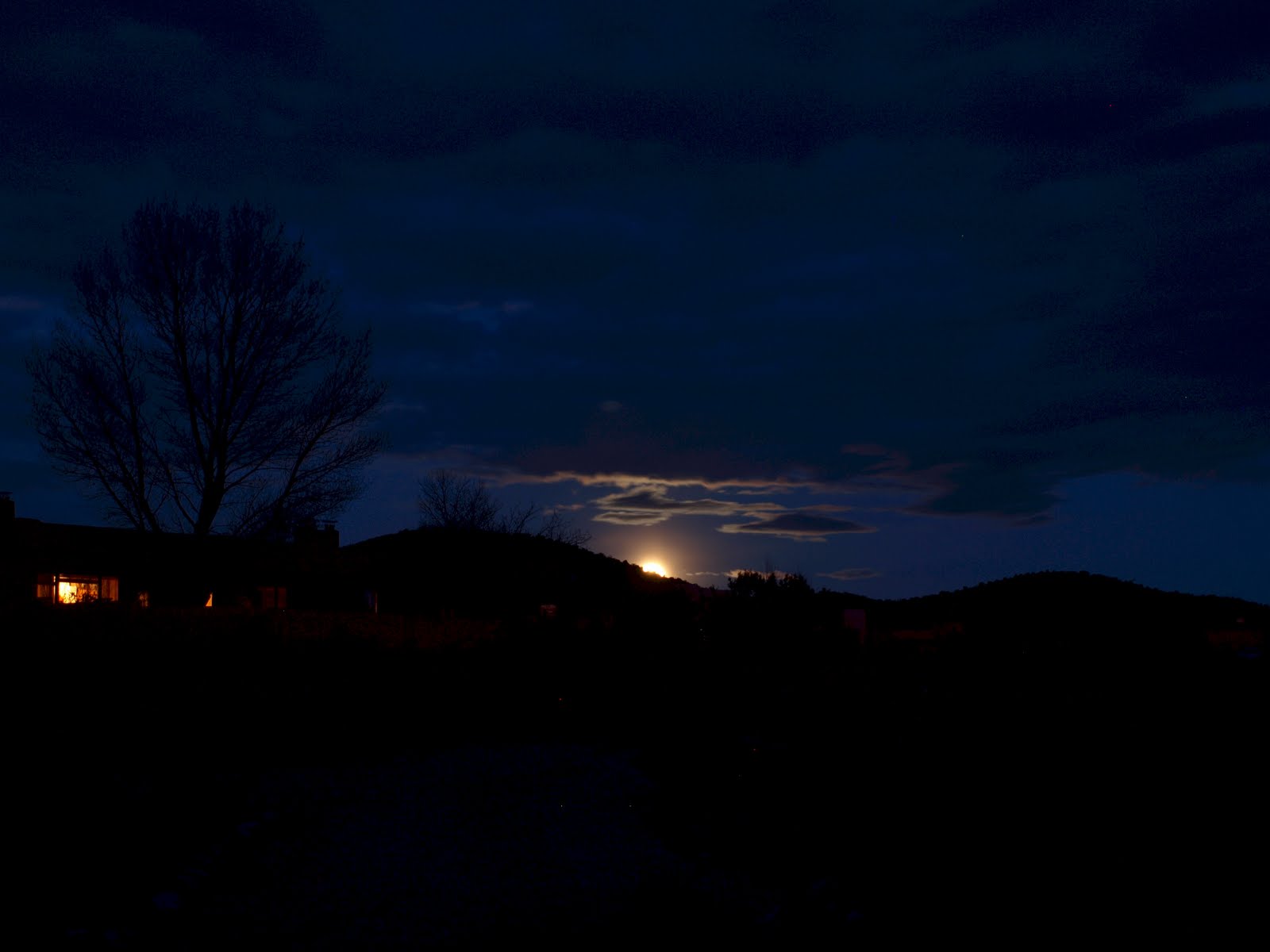
Full of light, it brightens the hills.

And the clouds above.

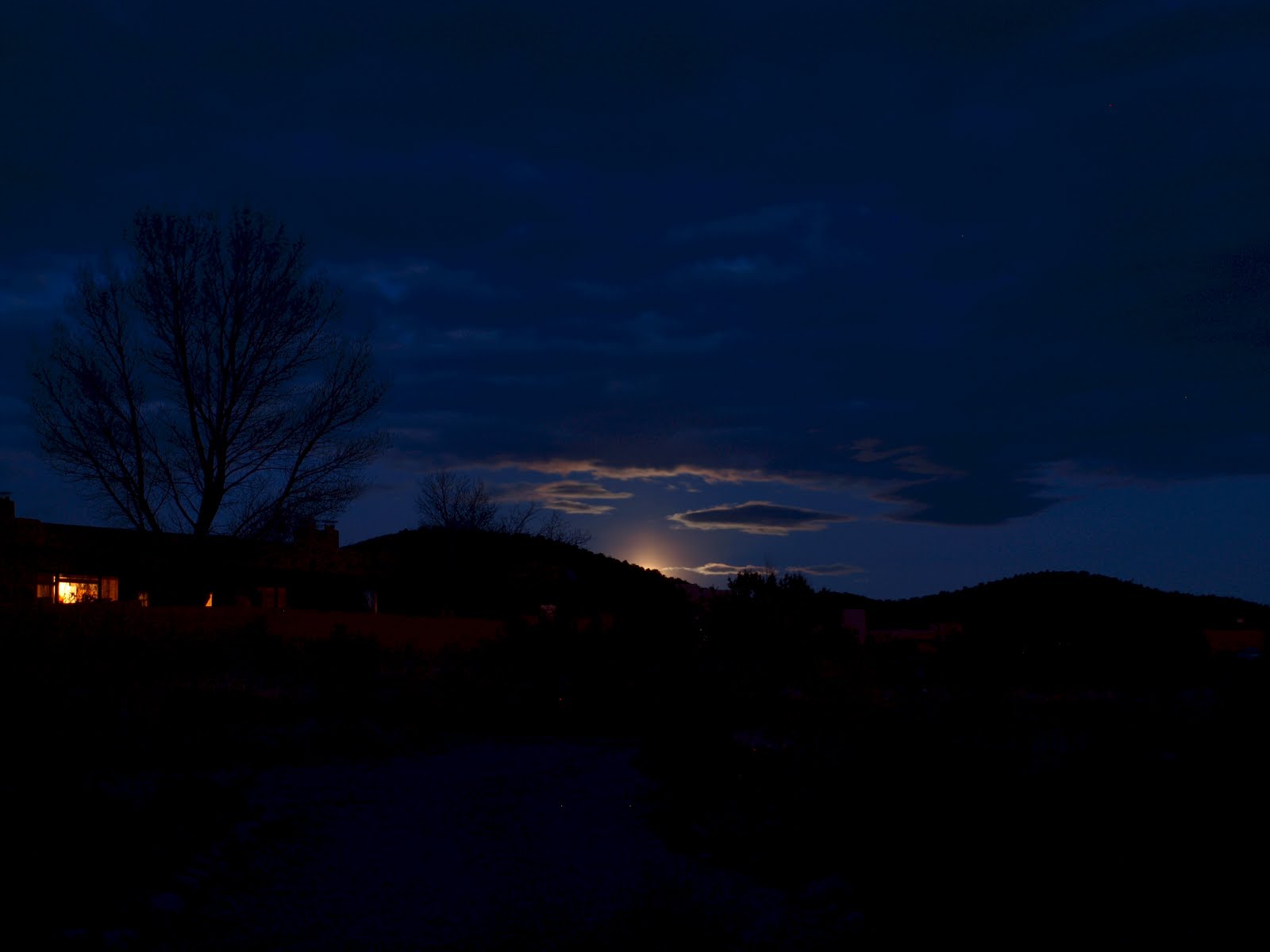
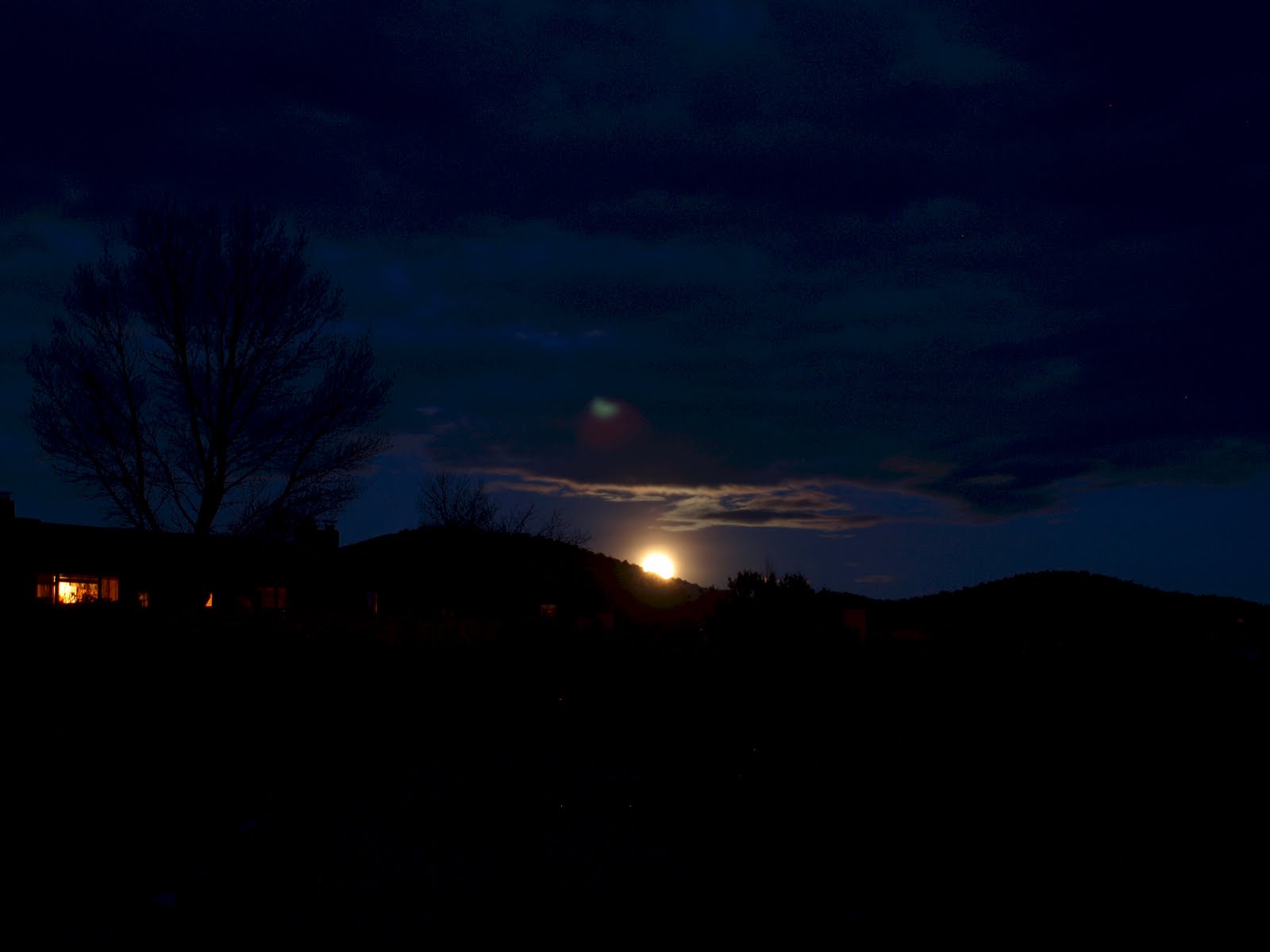
Nearly free of the hills.

And here is where I didn’t do so well. Hopefully you’re not feeling moonrisus interruptus. See how the focus is already blurring? The moon was so very bright, it took over the lens. All subsequent photographs look like a big white circle in a field of black.

Too bad, because my eyes could see so much more – the subtle shadows of the face of the moon.

I’ll get better at this, I swear.

Why I like writing? If, in the morning, the ending looks unfocused – I can always fix it.

Iggly Wigglies


My mind is blurry today. Sometimes I think the mucus from a cold gets in between the neural spaces and inhibits transmission. Yeah – I paid more attention in Neurophys than that. Still, that’s how it feels.

I’m trying to embrace the mistiness of it. I do believe the teaching that conscious thought is only the tip of the iceberg of our thinking processes. I like to have precise, clear thoughts, but I’m letting go of the idea that it’s so very important.

Still – mist is, by nature, a nebulous thing.

I love the look and feel of it, but when I try to capture it, it never seems quite right. Like the fog rolling off the Jimez mountains in the pic above. So spectacular in reality. Kind of meh in this photo.

I notice when my mind is less focused, that I tend to substitute words in odd ways. Usually it’s a sound-based substitution. For example, I once typed “actually” instead of “accidentally.” This is clearly not a spelling error or me not knowing the difference between the words. Somehow the cadence of the words are matched in my brain. My right brain, with all her lovely impulsive mistiness grabbed for a close-enough word and it took a moment for the left-brain monitor to catch up and correct the error. I did catch it, before I finished the sentence, but the bizarre substitution amused me. Sometimes I even type “know” instead of “no,” which is just more work to make the mistake.

One of my writer friends does this, especially when she’s struggling with a migraine. She wrote a blog post that mentioned “an arbiter of things to come.” I gently suggested she meant “harbinger.” She was chagrined, but I could see it’s exactly the same kind of substitution I make – based on sound and cadence. She knows the meaning of both words perfectly well, but they’re twinsies enough to switch with each other.

In my family, we call this an Iggly Wiggly. This is taken from the internally famous incident when my grandmother told me she’d been to the movies. I asked what she’d seen and she said “Iggly Wigglies.” Without a pause, I asked how she liked Legal Eagles. (For the record, she thought it was silly, which is probably a fair assessment.) Some of this is knowing my grandmother. A large chunk, though, is affinity for words and language sounds. I understood perfectly well what my grandmother meant, what my blogging friend meant, even what I meant.

It reminds me of that game where they take the vowels out of all the words in a sentence, to see if you can still understand it. Which we all can. As much as we cling to precision in writing, with proper spelling and punctuation, the actual communication usually makes its way through.

Or the accidental communication. I forget which.

Murky Is as Murky Does

A while back, I took a class in play-directing.

Okay, this was almost twenty years ago. So a titch more than a while.

At any rate, I had several reasons for doing it. I was in grad school getting a PhD in neurophysiology and all the science was making me feel like a left-brain cripple. Some of my best times in college had been running with the theater crowd. I took enough acting classes and performed in enough shows that I could have added a theater minor to my biology major, had it occurred to me. In grad school, I found myself lonely among the science-heads. I auditioned for a play, but I’m really not a very good actress. Where they didn’t know me, they didn’t even toss me the bit parts I’d had before.

(Yeah – the role I played in Equus? I totally got it because the director called me when the actress he’d cast was so offended at the role’s minor nature. Ask Jeffe – she’ll do it! It was fun, too.)

So, I thought I could break into the scene and make some little friends in the bargain, by taking a class. Finally, I was noodling about creative writing and I recalled how the Assistant Director of Equus had been an MFA student in playwriting and his adviser suggested he learn how to direct, to better understand how a script comes alive on stage.

(He also might have been a handsome blond from New Orleans with whom I had a little love affair, but that’s beside the point.)

It didn’t work out so well. I remained an outsider in the theater clique. Plus, because I was an outsider, I had a great deal of trouble casting my scenes – all the best people got snapped up by their friends.

However, I did learn something very interesting that serves me still today.

Though I seem to need to relearn the lesson, over and over.

The course culminated in two nights of One-Act Plays open to the public. Five of us put together about half an hour long plays. Mine was this creepy one (I forget the name) about a cold marriage where the wife kills the husband’s cat – either deliberately or through negligence. The husband then channels the cat (either becomes the cat or just flips out), stalks and attacks the wife.

It was a cool play.

And people liked it. They really liked it! (That’s me channeling Sally Fields.) I loved people telling me how they enjoyed it, with their faces lit up. You don’t get that in science. Then they’d say, “except I didn’t get if she killed the cat on purpose or not.” Or they’d say “I didn’t really understand if he was crazy or if it was the cat’s spirit.” This wasn’t in a contemplative, I’ll have to mull over the implications way. They were genuinely confused.

I realized that, in every spot of this little 30 to 45 minutes, where I hadn’t been crystal clear on what was going on, the audience hadn’t known either.

I thought I could leave some bits murky, but I lost them in every place I did.

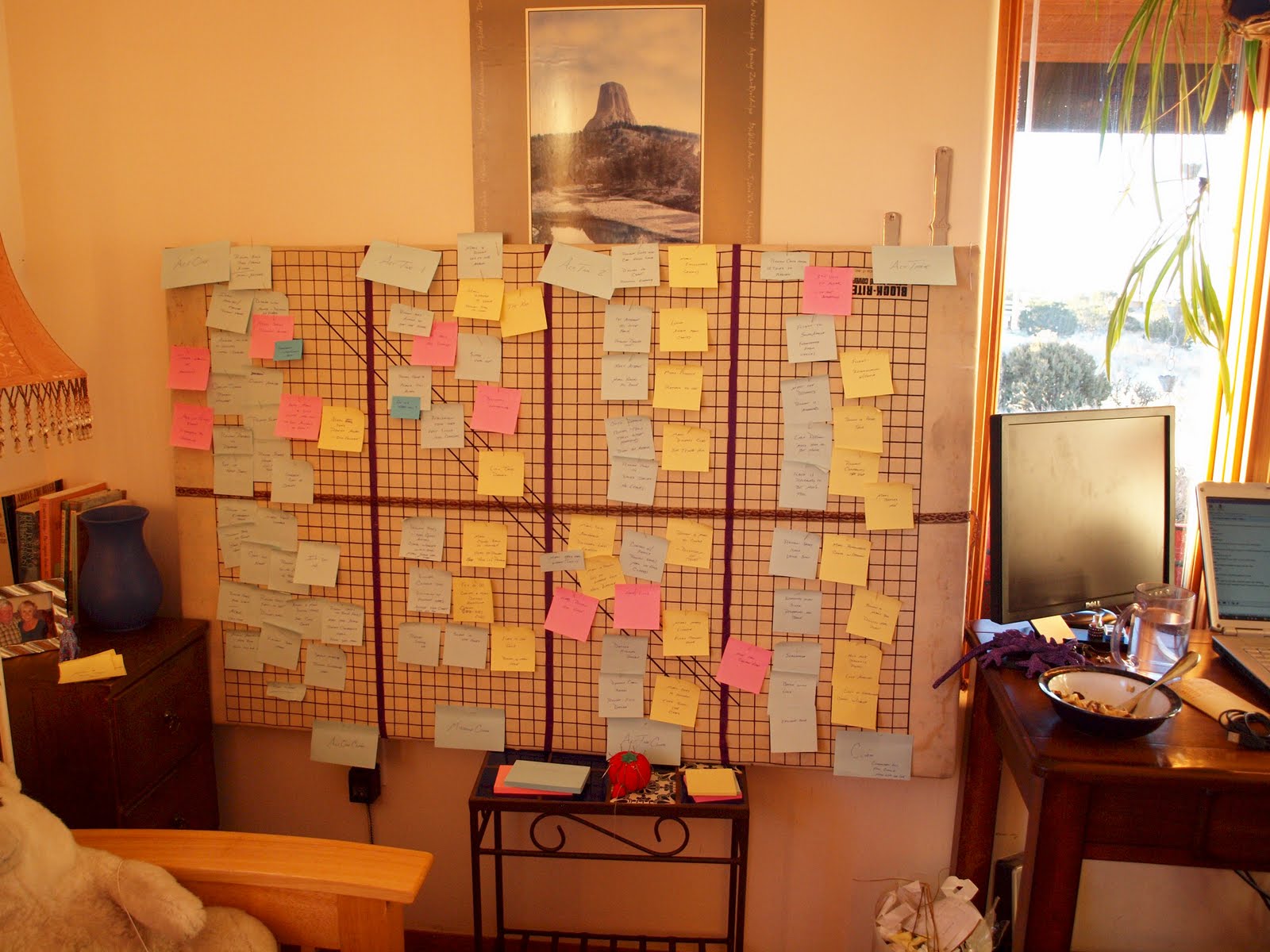
Yeah, you know where this is going. I’ve completed the storyboard for The Body Gift. You can see it in all its Post-It glory above. I’m eliminating an entire POV, because its murky and I have a choice of de-murking (yes, that’s a word) or nuking it. I’m not sure I can de-murk, so off it goes.

The pink and dark blue notes? Those are places where I’m not crystal clear on why the characters are doing and saying what they do and say. See, my particular curse as a writer is I follow the characters and write the story as it happens to them. This means that I have to find out things about their world that they don’t tell me straight out. It doesn’t feel to me like I get to make it up.

The writers who plot out ahead of time call us Pantsers, because they see us as flying by the seat of our pants. I prefer the term Mister. That’s how it feels to me – like I sink into the mist and things come to me out of it.

It’s just not always easy to get the exact right thing to come out when I want it.

But, it’s clear I have to. Where I was murky on this story, the readers were confused.

Lesson learned.

And remind me next time.

Rebuttoning

This is me, making La Peche Chocolate Velvet for Christmas. I rarely do much exotic baking anymore, so it was fun for me to indulge in that kind of creativity.

Yesterday I finished my revise and resubmit on Sapphire. I’m pretty pleased with the result – now it’s just cross my fingers time. I did a final spell check before I sent it off. I’m lucky enough to be a pretty good speller, so spell check mainly catches my odd words. Amusingly, Word doesn’t recognize a number of words I use. Among them:

Mons
Upthrust
Oversensitized
Skeezy
Tsk, tsked and tsking

The winner, however, is:

Rebuttoning, which Word suggested should be “rebut toning.”

Try using that in a sentence. “I would like to rebut toning arguments, but I know I need to work out more.” Erm.

And really, “skeezy” isn’t a word? (Incidentally, Blogger agrees it’s not.)

I like words. Always have. When I was in 7th grade, I started a list of good words. I had stuff on there like exquisite, writhe and oscillate. Words are my medium and I figure I get to work my medium as I see fit. Which means I might make up words now and again.

To me, this is very much like messing around with a recipe while cooking. When you first start baking, or even the first time you make a recipe, it’s best to stick very close to instructions. You have to learn the basics of how a dish comes together. It’s part chemistry, part biology, part magic. But, after you have that stuff down, then you can mess with it. I often reduce sugar and salt. But then, I kind of know how much sugar I really need to make the crystalline structure work correctly, or to feed the yeast. Salt creates a crucial balance to the sweet and brings forth other flavors, but it doesn’t take much.

A good cook also knows how to substitute ingredients. Not that a writer runs out of words like I might run out of, oh, almond extract. (All the grocery stores in Tucson sold out of almond extract – what was up with that??) But, after you’ve used the word “touch” 72 times, you start looking to replace some of those with alternatives. You get creative with it.

Sure, sometimes the substitute doesn’t work. The bread doesn’t rise, the souffle falls flat. Sometimes it’s brilliant.

The best part about writing is, until it hits the press, you can always tweak it.

Left Turns


This morning, as I ran on the treadmill, I saw a woman step out of the Spin class in the shop next door. She’d bundled into her parka, had her hat and gloves tucked under her arm and held her smartphone in the other. Reading some message on the phone, she smiled, pleasure suffusing her face.

I like that about seeing people texting and tweeting and messaging on their various handheld devices. It’s kind of replaced the old pastime of watching people greet each other at the airport, the hugs, squeals and laughter. People’s faces respond to the messages, making the same expressions they’d use in a face-to-face conversation. They grin. Sometimes they laugh out loud.

It’s not always the frowning and blankness detractors like to cite.

Marcella taught an online class recently on using acting devices in writing. She asked me to read over a description of a “left turn” that she wanted to use as an example. Here’s her lesson:

You’ve gone out for the evening, you and your spouse. It’s the first nice dinner you’ve had since the birth of your child. Dinner was relaxing. You actually got to have a glass of wine. You engaged in adult conversation. It was lovely. When you get home, the babysitter greets you at the door with a smile saying everything went fine. The baby is asleep. Looked in not ten minutes ago. You pay the sitter and she hops in her car for the short drive home. You sigh, content, as you and your spouse make your way upstairs to look in on the baby before getting ready for bed. Except, the nursery is still. Silent. Your heart stutters. You reach down to touch the infant. Cold. No breath. No life.

How do you react?

This was an acting scene set up. It isn’t real. Not here. Not today. Shake off any residual emotion, then come back with your response. When I asked, “how do you react?” What was your first, gut response? To scream? That impulse is the most common response to this exercise. It’s expected, which means it’s also a little trite as far as emotional reactions go. This is the point at which a director yells, “Take a left!” meaning, don’t go for the easy reaction. Do something fresh.

We’re not? here to talk about how to find the unexpected actions and emotions in scenes, but actions and emotions that ring true on a gut level for you and for your reader. In the scene set-up above, the actress playing the part turned to the man behind her, all the breath rushing audibly from her lungs, and began pounding her fists against his chest as he stood staring at the crib.

I’m Marcella Burnard. I write science fiction romance for Berkley Sensation. I also spent three years in the acting conservatory at Cornish College of the Arts, which resulted in a BFA in acting. It was there that one of our teachers gave us this scene as a way to introduce text analysis so that we could break down a scene, moment by moment, identify what the people in the scene want (their objectives) and then decide how each person goes about getting what they want (their tactics).

This idea stuck with me, that it can be fruitful for characters to behave in an unexpected way, to take a left turn instead of a right. (A recurring conversation during Christmas was that UPS and Fed Ex drivers are instructed to use only right turns, never left – urban myth or no?) I loved this example of a left turn – a simple thing that instantly enriches the characters and deepens the story.

It’s easy to write about people frowning at their Blackberries, to describe the unsettlingly blank expressions of teens absorbed with the iPhones. Seeing that woman’s smile this morning gave me ideas for ways to show all kinds of character from the one-sided silent conversations people have all around us.

Also? We followed a Fed Ex truck and it totally turned left. It’s all around us.

Snowfall and Sapphire

Did I say I wanted snow?

Ahem.

Okay, so the highways are closed. David has two finals today and we have no idea how the school will handle that. Considering that our rather long driveway is knee-deep to hip-deep in snow, I doubt David would be going anywhere even if they open the highways.

Yeah, you can say it now: Be careful what you wish for.

I received happy news last night that Sapphire made a bit of a conquest. The editor I sent the story to really loves it. She had a few issues with it and invited me to revise and resubmit, though she understood if I didn’t want to. These kinds of requests can go both ways. If you’ve been reading my blog for a while, you know I’ve revised before, to no avail. This is a different opportunity because she sent me a very detailed description of what she’d like to see revised. Better, they’re all really good suggestions. I really love getting to work with a sharp, effective editor.

A really excellent editor brings out the very best in your writing. Conversely, a bad editor can crush the life out of your work. By the way this gal zeroed in on the important aspects of the story and deftly picked out the weak spots, I’m thinking she could be one of the best editors I’ve worked with.

Not to mention that this is a very desirable press.

So, of course I’ll revise. It shouldn’t be too difficult. And when I wrote to say so, she replied that she’s delighted to hear it. All kinds of joy in Mudville.

The big question for me now is, do I set the new novel aside to do this, or work on both? I wrote a post for the FFP blog the other day, comparing writing a novel to raising a child. The new novel is just a toddler and requires a lot of daily attention. But now my teenager has her first big job opportunity. She needs new clothes, a haircut, pumps and hose! Kerry suggested that I give the toddler just enough attention to keep Child Protection Services off my back.

It’s an interesting problem, how to balance multiple works. When I started out writing, I wrote essays, usually in one sitting. I could hold the essay from beginning to end in my head and set it down on the screen. When I transitioned to longer works, I had to find a different way to see the story, because I couldn’t hold the whole thing in my head. At least, not in my conscious mind. I think I’ve gotten better at letting the entire story, including sequels, play out in my subconscious mind where I can look in on various scenes, to write them down. This requires a certain amount of immersion in the story for me.

To move two stories forward at once feels like another level of challenge. I know a couple of people who do this. Some alternate days or weeks on particular projects. Writers with contracts are often saying how they had to set aside a manuscript at the best part because edits arrived from their editor on another project with a one-week deadline.

I might try doing both at once, just to see if I can.

Heck – there’s not much else to do in January, is there?

Creation, Destruction and Writing

A lot of writer’s blogs give writing advice.

I’m not entirely comfortable with this.

Never mind the whole question of at what point in your career are you really qualified to offer advice on the art and craft of writing. I really couldn’t say. But I notice that people often pass around the same “lessons” on how you should do things. Frequently this kind of teaching is repeating what someone has told them, rather than from experience.

We used to run into this kind of thing with Kung Fu.

I studied and helped teach some of the Taoist arts for about 15 years. The three major internal arts, Tai Chi, Pakua and Hsing-I, are often presented as arts for lifetime practice. Like most arts, it takes time to learn the forms, the movements and the rules. Then you practice. Over time, you make it your own. Like most Taoist approaches, results are measured by your internal barometer. There are no real external markers for success.

Of course, our society isn’t much for long-term anything and we’re all about external markers of success.

Thus the weekend seminars where people learn Tai Chi, and then go teach it. To me this is a lot like passing along writing lessons that aren’t from actual experience.

So, I rarely give writing advice, except to talk about an experience.

I’m breaking that rule today.

I notice a lot of people complain about getting stuck in their manuscripts. Always at the same place. For some it’s starting, for others finishing. A lot of people hate the middle.

This isn’t just about writing a novel, it’s about dealing with all of life.

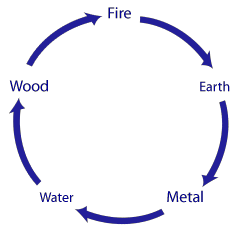
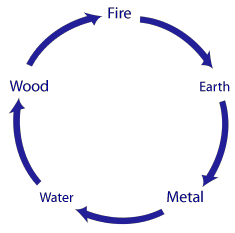
So, I give you the cycle of the five elements here. If you’re familiar with this sort of thing, you’ll know the principles of the five elements form the foundation for much of the Oriental philosophies. Yeah, I’m lumping India in with the Orient.

Here’s a nice simple chart. There are some abysmally complex ones out there, but we’re keeping this simple. So a basic way to read this is, water grows wood, wood burns into fire, fire reduces to ashy earth, earth transforms into metals and metals reduce back into simple water. Don’t get caught up in the logic – suffice to say their idea of “metal” is a bit different.

Instead, look at it this way.
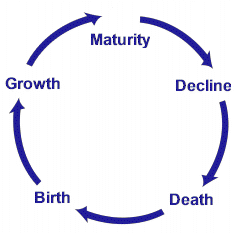
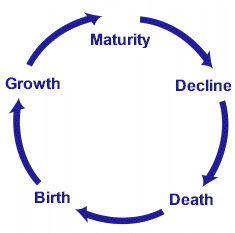
No, I’m not just randomly substituting. Birth is like water, like the primordial sea that is the beginning. Wood is growth, like the forests, plants and vines covering the world. Maturity is the fire, the balance between growth and decline. It can be nurtured to last a long time or can be a flash and disappear. Earth is the decline, the sinking back of growth into the ground. Death is the endpoint that cycles back into birth.

That’s one of the points. This isn’t a straight line; it’s a circle. Death makes birth possible.

You can match this to the seasons, too: Spring is birth, followed by summer, a moment or forever of midsummer, the decline of autumn and the death of winter – which gives way again to spring.

So, at last, my point:

We can apply this to writing our stories and novels. The analogy should be clear by now. You have your beginning that sets the stage, the growth of the story, the middle, which often contains the turning point, then the the decline, the wrapping up of the story and the ending.

Most of us are better at some points in the cycle than others. In our hearts, we already know which parts of life we struggle with. Some can start things; some can’t end them. Some get stuck between growth and decline with no understanding of what to do with it.

One writer-friend of mine has a hard time with decline, for example. She hates to let things go. Once they’re already declined, she can let them go into death, but she has a tendency to try to keep things from declining. That’s where she gets stuck.

Me? I don’t like killing things off. I like things to last forever. So I practice. I try to embrace the end of things in my life. Kill it off and let it go.

I’m not necessarily good at it.

Ah, but the birth that follows is a glorious thing.

Ben/Ben//Matt/Matt

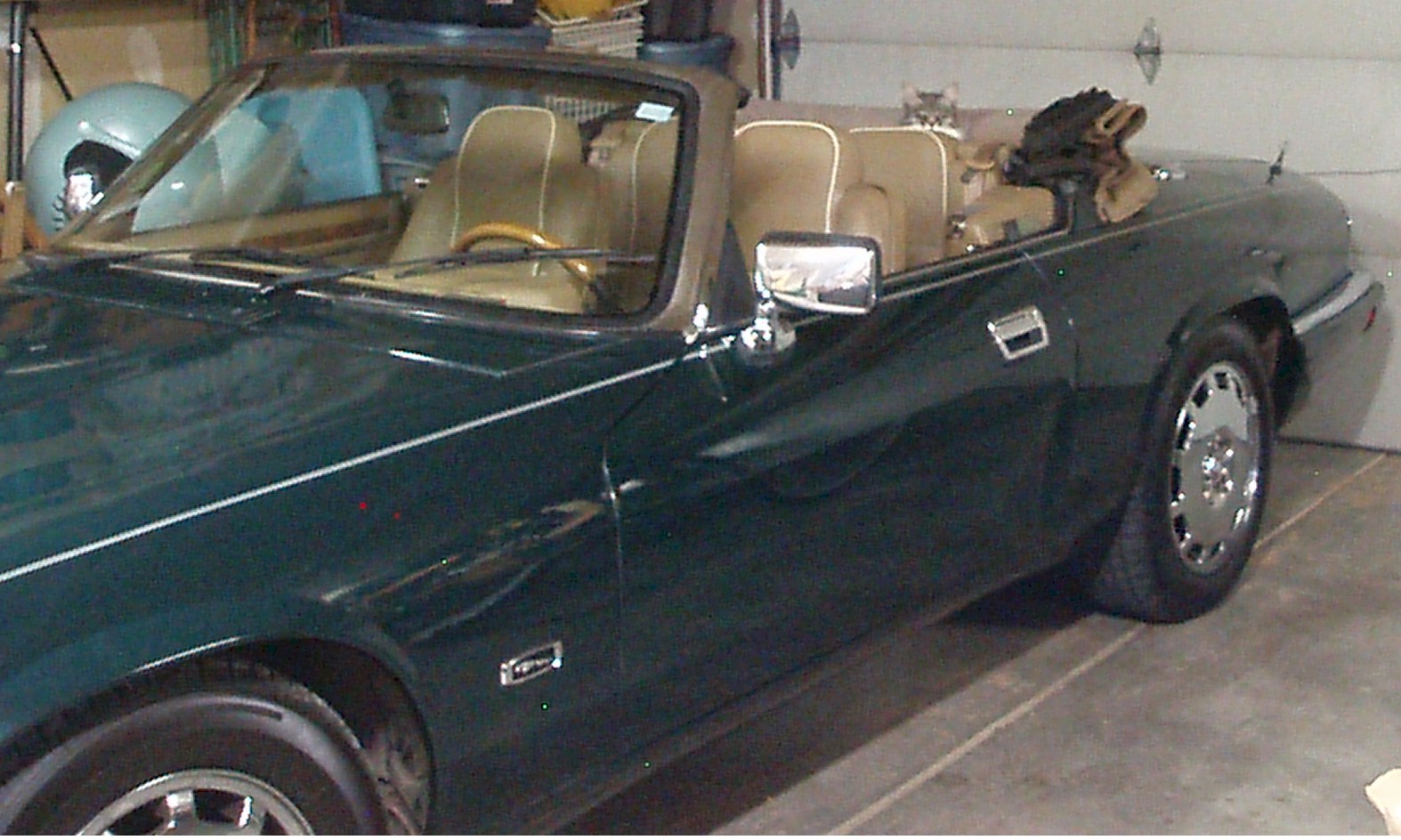
Another in the “Isabel gets to sleep wherever she wants to” series. She spent several hours napping in the folds of the convertible hood.

No, I’m a softie – I didn’t make her move. If she thinks it’s a good spot, then fine.

It also gives her a good vantage point for mouse-hunting, which is always on the approved activities list.

I was thinking the other day how I’ve long had this tendency to mix things up. For example, there was my whole Ben Affleck/Ben Stiller, Matt Damon/Matt Dillon mix-up.

Yeah, my friends made fun of me no end for that one – you don’t need to chime in.

But see, let me explain. First, my brain apparently indexes by first name. No, I don’t know why. In my skull space, Damon and Dillon are really similar words, too. It’s a cadence thing. This was back when Good Will Hunting and Something About Mary came out. Both got lots of buzz and I read articles about the Ben Affleck/Matt Damon screenwriting team and how clever they were. Ben Stiller was just really starting to impinge on our consciousness as a comedian and Matt Dillon got nice write-ups for his performance in Something About Mary.

So, at some point I decided that Ben Affleck and Ben Stiller were the same person. I don’t know, maybe “Affleck” was too hard to remember. So I had him as the same guy in both movies. They kind of look alike don’t you think? If you put the difference down to make-up? No?

Well, *I* thought so. I was confused, okay?

But where I got really messed up was that Matt Damon and Matt Dillon arguably look absolutely NOTHING alike. I kept looking for Matt Damon in Something About Mary and not seeing him. People said, oh, he’s the private eye and I would study him thinking, whoa! that’s some seriously good make-up.

Yeah, okay, point and laugh.

I finally got it sorted out and it’s even more laughable now, given how all of their acting careers and public scandals (or lack thereof) have since diverged.

It came to mind when I did it again the other day, mixing up authors Jennifer Weiner and Jennifer Crusie. (See? It’s the first name indexing again.) That’s not quite so terrible, since they write books in similar veins.

It occurred to me though, that this silly flaw of mine, this tendency to mix things up, is parallel to how I draw disparate ideas together and tie them up in essays and stories. Readers often comment they like that about my work, how I bring things together they hadn’t thought of before.

Shakespeare used that theme a lot – how the hero’s strength (yes, it was always the hero and female characters were mainly foils, alas) also contained his fatal flaw. And the fatal flaw is what would bring the hero down in a tragedy. It’s interesting that, in a life, our flaws can contain the seeds of what makes us special.

Maybe that’s part of what being true to yourself is all about.

I Need a Heroine


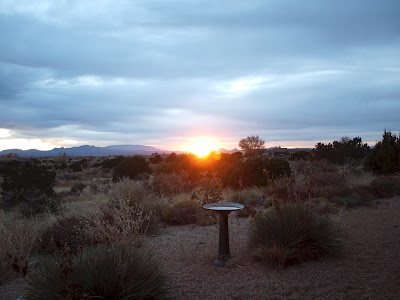
We’ve fallen into our pattern of afternoon monsoons here in the high desert of New Mexico.

Our mornings are bright and clear for the most part. Mid- to late-afternoon brings the storm clouds. Black bottomed, they lumber up the valley from the Sandias and drop rain in great washes of benediction.

The dog cowers in terror at the storms, sleeping as nearly under my chair as he can manage, while the cats snooze in the cool damp air.

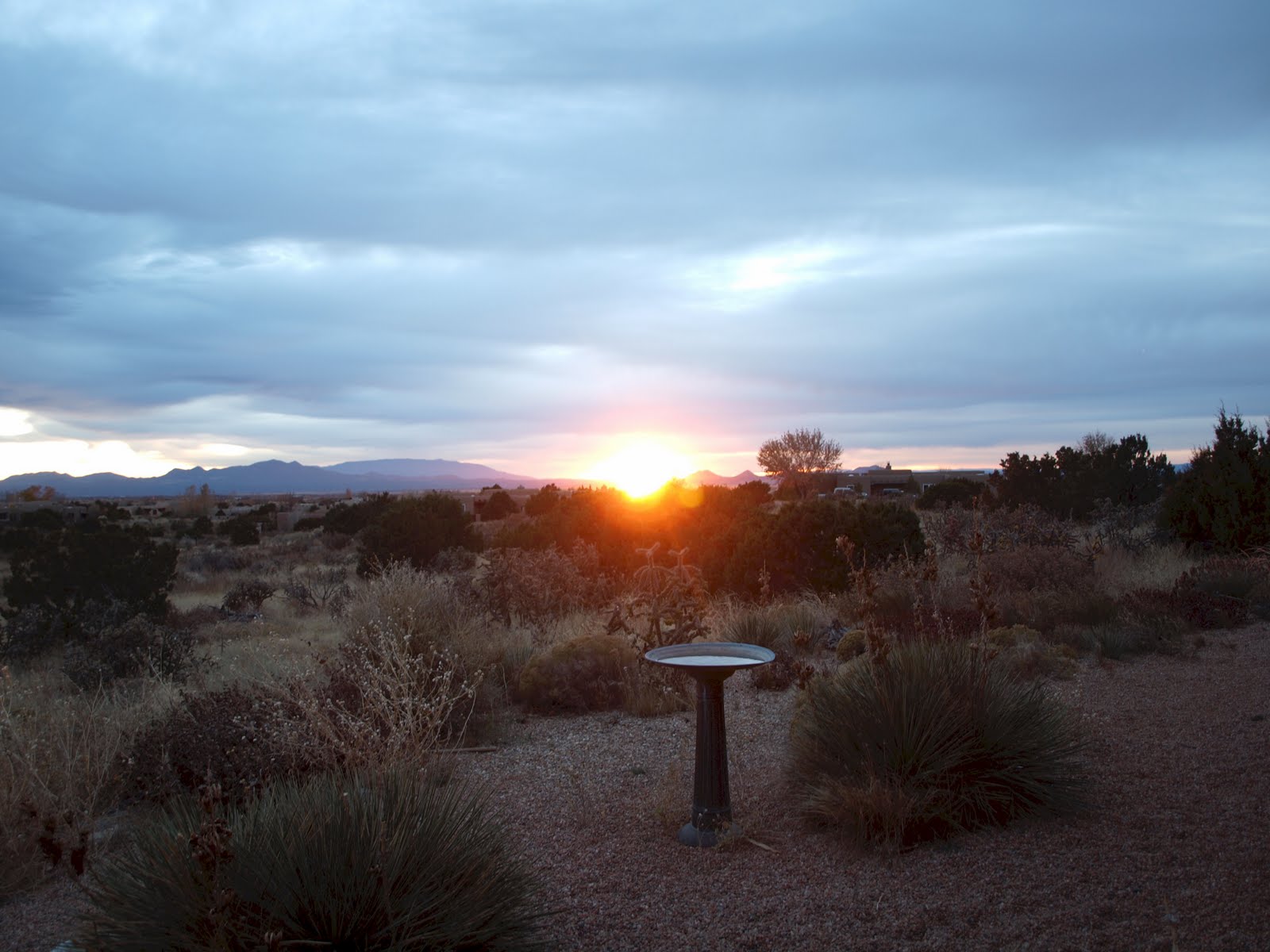
Sunset blazes into glory, illuminating the scattered storms, turning the clouds into pink and cold fantasies. Sometimes the rain comes in again, rising and falling through the night.

Apropos of nothing, I know. But it sets the pattern of our days.

I haven’t liked the last couple of books I’ve picked up. I thought maybe it was me and my mucus-addled, over-tired brain, so I kept trying. One, though, I’ve given up on. I just couldn’t like the heroine. She’s a succubus and a victim. She staggers from one sexual encounter to another, as she has for centuries. The sexual acts are unrelentingly graphic and, worse, repetitive. I know this might sound funny coming from me, but I get bored of it. Worse, I feel soiled. I know that she must get her act together at some point, become strong and triumph over all. In my heart I don’t believe it. She’s not real to me and I’m halfway through. I couldn’t bear it any more. I finally put it down.

The book I picked up is by a totally different premise, by a Famous Author, who I hadn’t read before. This heroine is sweet, nobly wanting to save everyone. She is also a victim, passed over at work, unlucky in love for unclear reasons. I’m wanting to like her and I’m having a hard time. I don’t quite understand why the author is so highly regarded. The insidious thought creeps in, even as I’m talking to editors and agents about my own beloved novel, will I become one of these authors who resents the bestsellers?

I’ve never been that sort of person.

But the market is funny now. There’s gluts of certain kinds of books, publishers hopeful of tagging along with a trend. Everyone is searching for the new permutation of the kick-ass heroine. Maybe the drug-addicted, the abused and overlooked are the natural starting points. Maybe it’s just me.

I find what I’m missing is really good characterization. I mentioned the other day that Susan Elizabeth Phillips advised that you should write characters the reader can’t bear to be parted from. Her heroines are not always admirable to begin with. In Ain’t She Sweet, the heroine was a stuck-up, nasty girl in high school who treated people badly. She returns to her hometown, where everyone hates her, broken and defeated by life. By the end of the book, you just love her and how she overcomes it all.

Susan is right – when I think of the books I love most, I think of the characters. They’re like real people to me. I miss them and sometimes go back to re-read, just to spend a little time with them again.

That’s the magic.

One-Eye Blind

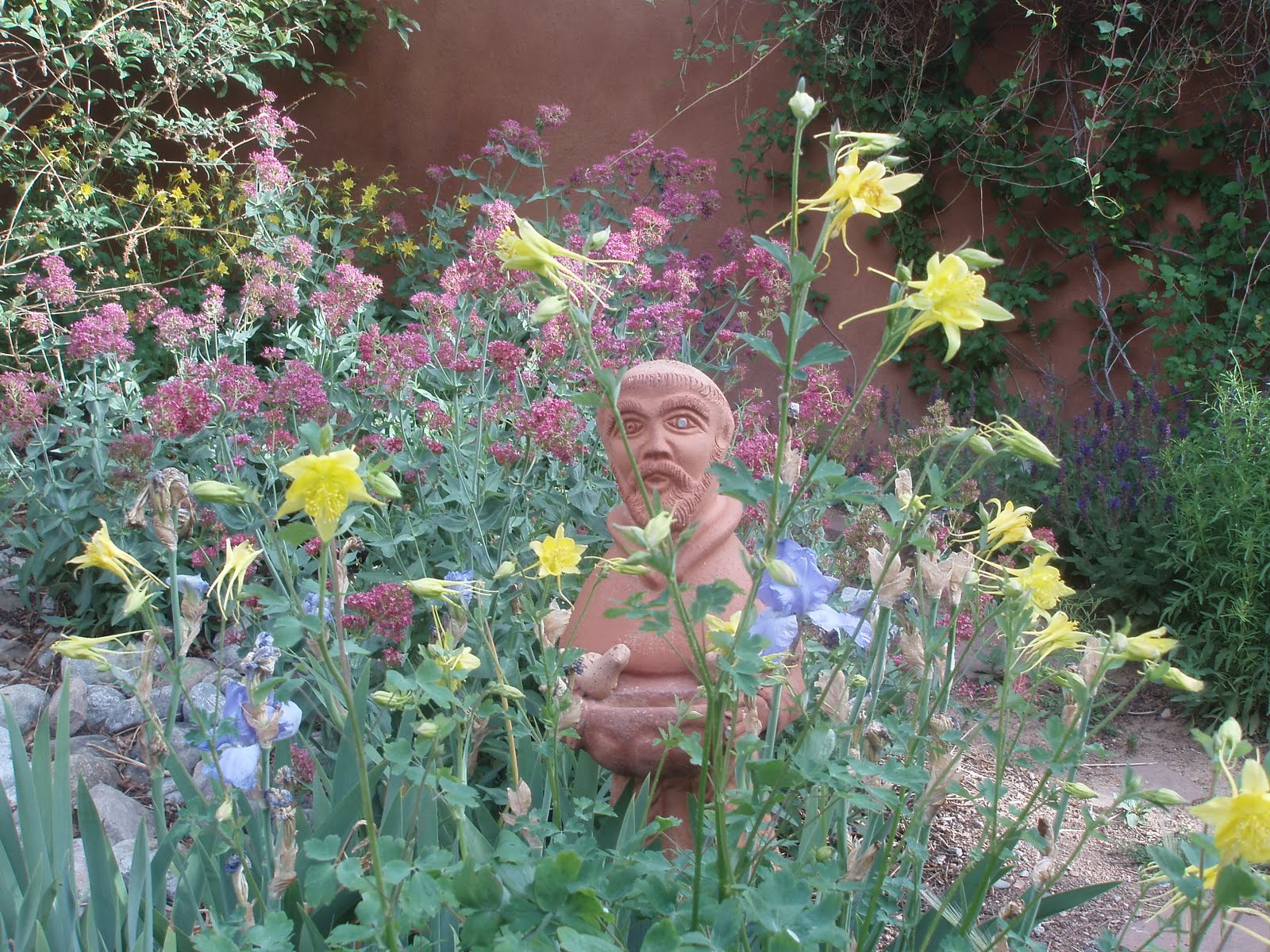
I didn’t notice, until I went to take this photo of the pretty flowers, that St. Francis is now blind in one eye.

Apparently some sort of insect has built a cocoon or egg sack in the cavity and sealed it over. I can’t decide if St. Francis’ love of all animals extends to insects. You don’t really see him depicted with, say, a preying mantis on an outstretched arm. Still, life is life and I’m inclined to let whatever it is develop as it will.

That tends to be my philosophy on most everything. And not just because I’m lazy.

I think that’s why Taoism fits me well: just let it flow, swim with the tide, ride that wave into the shore.

It’s how I write, too. I usually have just a general idea of what happens, but not exactly. For example, right now my characters are visiting this sacred altar. I knew it wouldn’t be easy to get to, being secret and sacred and all, but I wasn’t sure what the tricks and traps would be. I found out as my characters went along. Now that they’re there, I’m not sure exactly who or what occupies the altar. It hasn’t jumped out yet, either, which gets kind of frustrating.

I’m really not sure what I think about this kind of thing. Robin McKinley, who I just love, and who writes this nearly incoherent, stream-of-consciousness blog that I can only sometimes bear to read, writes here about why there’s no sequel to Sunshine, a book well-loved and which clearly ended begging for a sequel. She does the thing some authors do, saying that the stories come to her and she can’t make it happen. Other authors talk about their characters talking to them. The pre-plotters brainstorm it all out ahead of time and then, depending on their technique, either write it exactly that way or let the story wind around that structure.

I don’t know if I believe in the “stories are given to me thing,” though it fits within my Taoist inclinations. I don’t know that I think it all up myself, either.

I do know that the answers don’t come to me unless I’m writing what’s happening to the characters. Or letting the scene play in my head – that sometimes works. I think sometimes that it’s a combination of both, like most things. I point the imagining part of my brain in a particular direction and let it run. The neurons pull the energy from wherever they do and spin the story. Part of me can see it and part is blind.

Quite remarkable really.