What Happens When You Talk About Writing Instead of Doing It

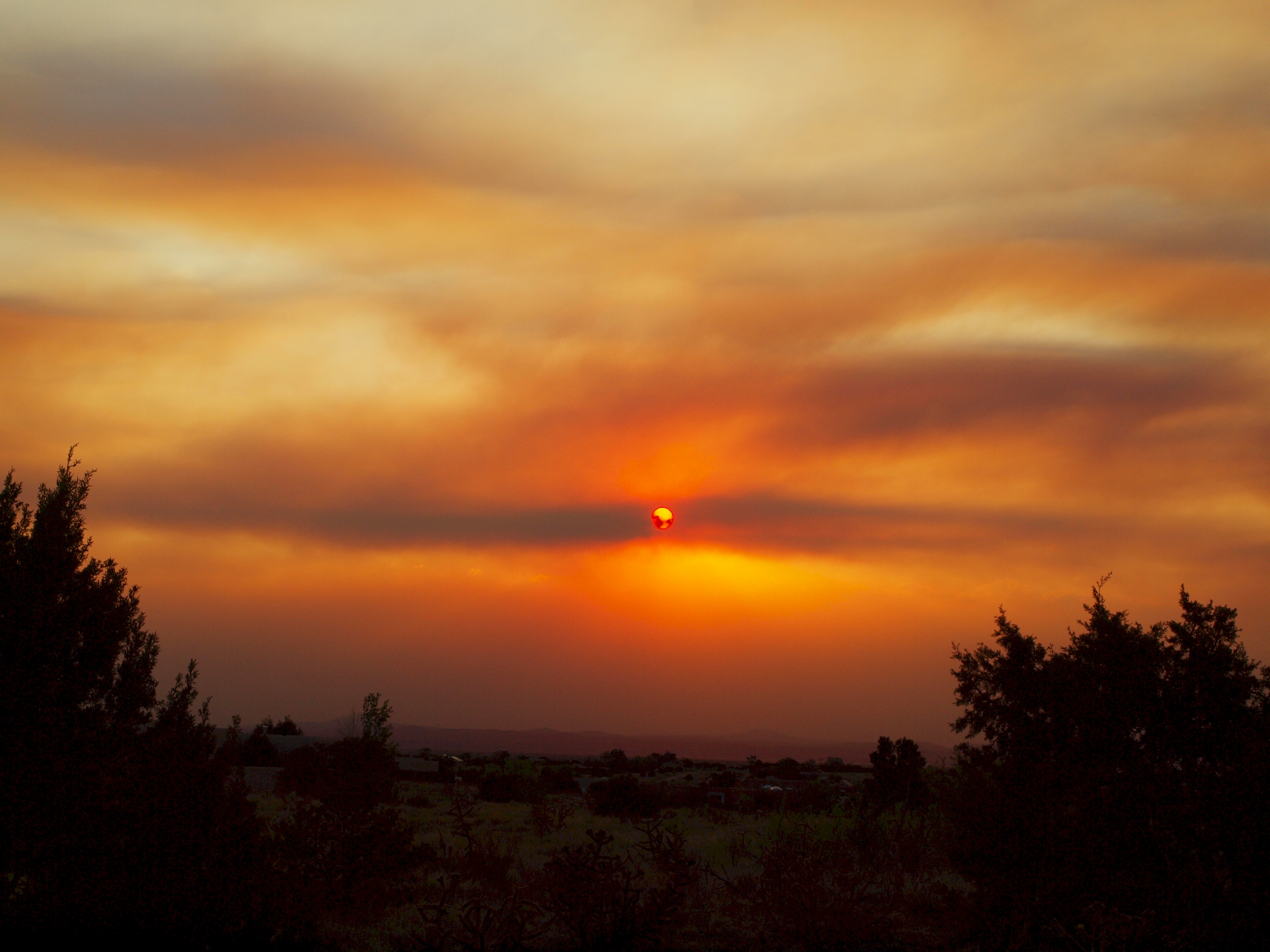
This was smoke from the Gila fire drifting our way Friday evening. Fortunately the cooler air over the weekend subdued the fire quite a bit.

When I was in college, I imagined sometimes that a TV or movie camera was following me around. For a long time I thought this was a weird thing about me, weird enough that I never told anyone. Later I discovered it has a lot to do with my personality type and a tendency to view my actions from a certain remove. I’d especially do this when I was trying to learn something new.

For example: studying.

In high school, I never really learned to study. Memorization felt pretty much effortless. If I heard or read something once, I retained it. With the possible exception of calculus, but I had a bad attitude there. In college, however, the sheer volume of information meant I had to work at learning and memorizing – and I had no idea how to go about it.

So, I kind of did it like in the movies. I went to the prettiest libraries on campus. I set out my books and supplies. I did everything I could think of to look like I was studying – perhaps a romanticized version of it, but still – and hoped that would do it.

Of course, this was silly. Creating an external appearance does not create an internal process. That took a different level of effort. One that had nothing to do with how I looked from the outside. It’s akin to the temptation to talk about a thing instead of doing it.

This has been on my mind because I notice writers doing this, especially newer ones. Social media creates the venue for the “look at me!” moments. And the support network is great for staying motivated and not feeling like you’re working in a vacuum. However, writers are especially prone to talking about writing instead of doing it. Ostensibly, waxing on about your plot and characters is giving you a chance to think about the story, but every moment you’re talking about it instead of doing it, you’ve lost time. That includes tweeting about it.

I’m kind of amused by the #amwriting hashtag on twitter. Not that it isn’t a useful way for writers to connect. It’s just that, every time I see it, I want to reply “really, you’re #amtweeting.”

My point is, all of these internal processes – writing, studying, learning – occur where no one else can see, deep inside the locked box of our skulls. What someone else sees when they look at you is totally irrelevant.

Magic occurs in the dark, without witnesses.
 

Ducking the Spanking

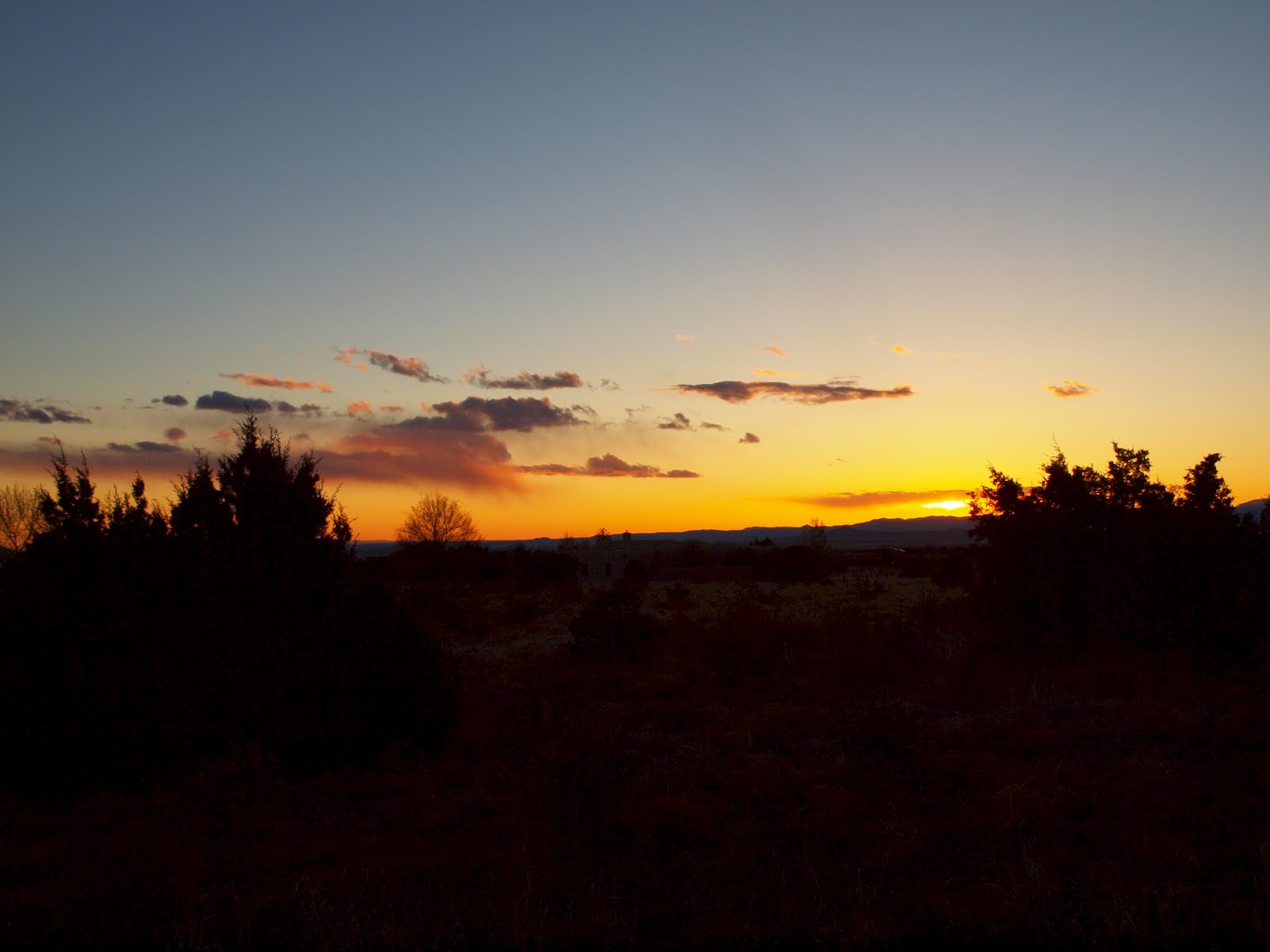
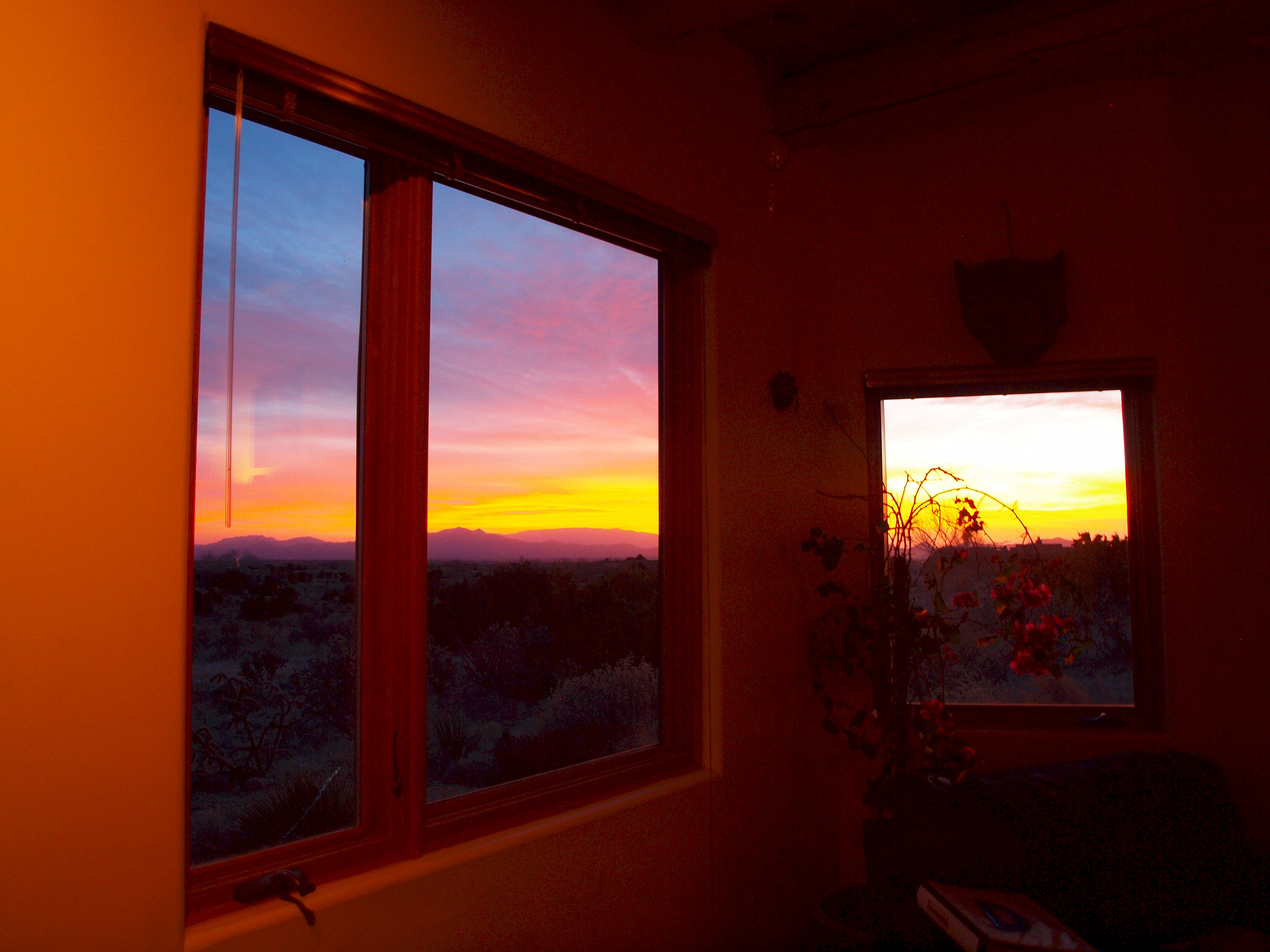
One of the things I love about this house is how the sunset fills every window. I don’t often take photos from inside the house, but I thought I’d try. Can’t get all the windows very well, though.

Hmm. Maybe I need a panorama card for my camera!

Writers tend to have funny conversations. If overheard, they might sound quite alarming. Discussions of how best to kill people, how to dispose of the bodies, argument over what kind of childhood trauma is the most scarring. For writers of the smexy, it can get particularly interesting. Especially when you’ve worked with the same critique partners (CP) long enough to have shorthand references.

The other day, I told one of my CPs that she was ducking the spanking again. No, not like when we were kids and hoped mom and dad would forget about the promised punishment. This referred back to a story she wrote, with BDSM elements, where the prospect of a spanking was held out for most of the story and, when the moment arrived, she glossed it.

Voodoo Bride knows about this. There’s nothing worse (for readers like us, anyway) to be promised a sexually intense situation that never materializes or is glossed over. The whole point of something like a spanking scene is that it’s intense and difficult and puts the characters into an extreme situation. It’s a very human and polite tendency to back away from tremendously fraught situations like that.

However: this is the story gold.

So when I read my CP’s story and felt like she’d created a very tense, difficult scenario and then defused it by making it not so bad after all, I could tell her she was ducking the spanking and she understood right away.

Now, I’m not saying you have to include a spanking scene, metaphorically or literally. If you don’t want to go there, don’t. But, if you include something like that, then follow where it leads, into all the dark, twisty, intense shadows.

If you’re going to have a spanking, make it a good one.

Aaaandd on that note – you all have a great weekend!

Best Writing Retreat Ever

You all know the saw – writing is a lonely gig. And that’s why having friends and critique partners can be so very important.

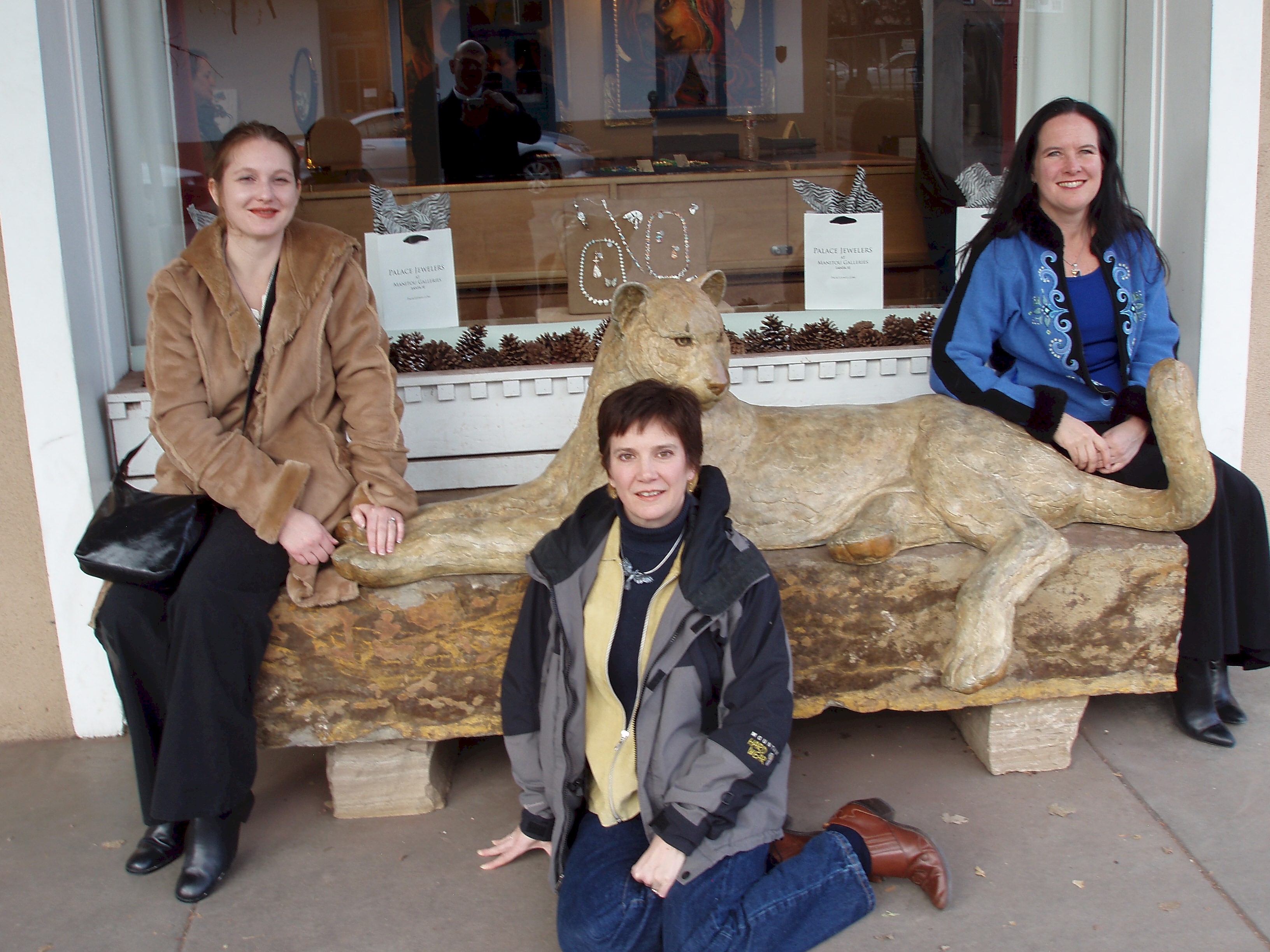
This last weekend, Laura and Marcella came to Santa Fe to visit me. We had a lovely time. We toured around the countryside – I’m sure they’ll share some of the adventures – soaked in the hot waters at Ten Thousand Waves and did some major shopping. We each managed to buy a few special somethings, to reward ourselves for hard work and to provide inspiration in the next year.

Over our last lunch, Laura made us get down to business and set goals and plans for the coming year. She’s the accountability girl.

We’d been talking writing all weekend, of course. Chewing over plot ideas, sympathizing over business annoyances, coming up with great book ideas and insisting that the others write it. The goal setting was the culmination of all those winding conversations. We probably wouldn’t have come up with the same things that first day. But after all those hours of working things through, everything seemed much more clear for what needs to happen in the coming year.

It wasn’t a writing retreat, because none of us really wrote. (Except for Marcella who was dutifully marking down ideas in her notebook.) I kind of think that if we’d formalized it, the energy wouldn’t have worked so well. No lectures, workshops, official brainstorm sessions. Instead the ideas ebbed and flowed in a natural way.

We’re thinking about doing it every year.

Thanks ladies!

After the First Mile

David and I have been dragging rear a bit this week. It’s probably a mild virus, possibly something that hitchhiked from the tropics. Not awful, but we haven’t been hopping up and hitting the gym like usual.

Today, though, we mustered up the will power and did the workout. Afterwards, David said, “It didn’t feel good at first, but after the first mile, I got my rhythm and then it felt great.”

You know me – I thought of writing.

I’ve been working my way back into the groove this week with Middle Princess. I know I’ve talked about it before, how difficult it can be to get back into the writing every day and, more, trying to hit at least 1,000 words/day. A lot of people out there are doing NaNoWriMo (National Novel Writing Month), which calls for 50,000 words in the month, or about 1,666 words/day.

For me, I’ve really found that that first mile is really the hardest. Wordcount-wise, it’s somewhere around the first 350-400 words. Those can be painful and take forever to get out, but after that, it starts to feel good. Oh sure, some days I have to eke out to the very end, but often if I can just get past the 500 word mark, I can go pretty easily.

David said he thinks the hormones kick in after the first mile and I said, no, that shouldn’t be the case, because I see it with the writing like this.

What I think it is? The subconscious. Our subconscious is like a little kid or a pet. They like to play, to have fun, to run around and enjoy life. It’s the conscious, the left brain, who says “no more goofing off. you’re going to sit down and accomplish something.”

No, the subconscious doesn’t like hearing this. And, like a toddler or a puppy, it will test you.

Oh look! A yummy book to read!

Oh, let’s go outside!

What’s going on in Twitter-land?

If we want to get something done, we have to keep gently steering the subconscious back on task. I do mean gentle. If you scream at it, it’ll shut down and sulk.

But, if you keep running on the treadmill, keep tapping those keys, eventually the subconscious will play along. Then it starts to have fun. And, that, my friends, is when you hit the glory point.

It’s there. Believe me.

Seeing Through the Fog


Overnight, all those overcast skies that have haunted us dropped down into the valley. I think this is a better photograph, more dramatic. I used the telephoto lens to show you how really neat it looks.

But that perspective is a bit misleading. Here’s how it looks with my other lens, that I usually use for landscapes.

Now it looks a bit less like the fog is billowing up for attack. But you also lose some of the sense of it. This is how our eyes – and brains – are still superior to cameras. I can look out and see both aspects at once. Not even as switching back and forth, but in combination with each other.

I think about this kind of thing a lot.

It seems that writing is a constant decision-process on which lens to use. Do I want to focus on the complex politics of my Twelve Kingdoms? On my heroine’s private pain? When do I back up and give a glimpse of all the tiers of people who make up life in the castle? When my hero and heroine are finally alone, do I leave the room? (It turns out that no, I am apparently incapable of leaving the room.)

There’s all sorts of rules for creating close point-of-view (POV), so the reader feels very involved in the story, but I seldom see advice on when to pan back. When to let the reader see the bigger picture. And yet, from these kinds of choices, extraordinary scenes are created. Sometimes you just have to follow your instincts, I suppose.

Or cheat, and show both.

Dread, Procrastination and Bad Hair Days

You, my faithful blog-gobblers, know I’m all about the “write every day” thing.

I know. I’m militant. I stand by this.

But.

I don’t think I’ve ever mentioned the days when this doesn’t work out so well. Jami Gold wrote an interesting post today about giving yourself permission as a writer, on a number of levels. One of the things she touched on was the off-day and letting that go.

Everyone has off days.

You know what I mean. The Bad Hair Day. Those days that, for whatever reason, things just don’t flow right. If we weren’t committed to dealing with careers and families and things like keeping fed, we’d likely just crawl back into bed on those days and hide under the covers.

Few of us have that luxury though. We are committed to things that must get done every day, so we forge ahead, painful and unproductive as it may be.

That’s my point with the write every day thing.

For some reason, writing – maybe any creative endeavor, I don’t know – brings with it Dread and Procrastination. These evil twins perch on a writers shoulders and whisper of other things that need doing. Dread worries that the the plot line is muddied, that everyone will hate the book anyway, that maybe this is all a Terrible Mistake. Procrastination wonders what people are saying on Twitter, if any email has arrived and, oh, there are dishes in the sink! The twins have a common goal: to keep you from writing. I don’t know where they come from, but every writer seems to have some form of these nasty buggers.

The reason you sit down to write every day is to shake Dread and Procrastination from your shoulders.

Wherever they draw their power, it’s thwarted by habit. By ritual and sacred space. They fade away in the face of it until their little voices can’t be heard. That gives you the space to write. Whether that goes well is something else entirely.

Sorry.

But, I offer this. Those days when the words don’t flow and you stare at the screen? They totally count.

That’s writing, too.

If writing was only tippy-tapping words onto the page, then monkeys *could* do it. What we do is story-telling. We fit words to the story, yes, but that’s only one piece of an enormous subterranean process.

Hence the staring at the screen.

And the gazing off blindly into the distance.

The dreamthink.

So, I totally agree, Jami. Sit down to write every day, if only to shut up Dread and Procrastination, but I like your idea of Permission. What happens once you engage is all good.

No matter how your hair looks.

Story Intrusion

This is Isabel’s favorite summer snoozing spot – on the east side of the house, in the shade, where she gets a lovely little breeze. It has the added bonus of a wall she can put her back against or, as she is here, press with her back paws.

Yes, I have to go pet her all the time. The cuteness is too much to resist.

The other evening I was out on the patio, too, reading Zoe Archer’s Blades of the Rose bundle. (For those of you not snapping up every ebook deal you can find, a “bundle” is like a digital box set. In this case, I was able to get all four of the books in her Blades of the Rose series for the price of one book. Fab deal. The only thing is, Kindle measures reading progress by percent, not page numbers. So, when you’re reading four books essentially at once, you’re stuck in the low percentages FOREVER. 3%. 4%. 5%. I have to get over it… But I digress.) While I was reading her lovely story, bits of The Middle Princess started floating through my head.

This is a good thing. First, it means that Zoe’s stories are inspiring and put me in the best frame of mind to create my own stories. I think it’s really a high compliment to the author. Second, it means that Middle Princess is talking to me and that part of me is connecting to the story even when I’m not actively writing. I don’t know how other novelists do it, but I really need that kind of ongoing flow, especially since I can’t work on it all day long. It’s also a lovely, dreamy feeling.

The phenomenon reminds me of REM intrusion. REM is Rapid Eye Movement sleep, of course, or dreaming sleep. What’s really interesting about sleep-deprivation studies is that they all show that the main effect of sleep deprivation is sleepiness. This seems silly until you think about it. The symptoms of sleepiness – feelings of fatigue, intense desire to sleep, blurred vision, murky thinking – all intensify the more sleep is missed. With sleep, the symptoms disappear again.

The really measurable effect of sleep deprivation is when REM sleep is lost.

Studies have been done where people were allowed to sleep as much as they liked, but were awakened whenever their brains kicked into REM. This has dramatic and rapid effects. People quickly lose the ability to make rational decisions instead of emotional ones. The most minor problem becomes insurmountable. After a few days, the need for REM state becomes so desperate that the brain spontaneously goes into REM even while people are awake, called REM intrusion.

Yeah, you actually start dreaming while you’re up and about. Puts a whole ‘nother spin on hallucinations, doesn’t it?

I kind of wonder if Story Intrusion (my term) isn’t similar, though less pathological. I hope.

Maybe I’ll go have a nap by the side of the house.

Five-Year Plans and the Monkey’s Paw

Sunset catching distant rainfall last night. Gorgeous shade of rose.

So, last week I talked about Danbling and Overthinging in plotting a series arc. Theoretically plotting one, since I’m not much of a plotter. But one of the insightful comments made me realize WHY I’m not much of a plotter. It comes back to how I live my whole life and The Monkey’s Paw.

You remember that short story, right? I think we all had to read it in school. The monkey’s paw grants three wishes, but at terrible cost to the wishers. I don’t want to blow the story if you haven’t read it, but it’s the syndrome where you wish for a million dollars and then your kid gets killed by a city bus and you get a million-dollar settlement. The moral of the story is that you shouldn’t interfere with fate, “they” say. That’s not so much the story I carry away, not being all that into fatalism.

I totally believe we map our own futures.

But.

I don’t think we can control it.

See, I’ve done training in a bunch of those systems where you map out a one-year, five-year, ten-year plan. You visualize exactly what you want, how you want it and precisely when. Most of the success gurus build off of this idea, in one way or another. The “exact” and “precise” aspects are meant to duck the monkey’s paw curse. You don’t let the tricksters mess with you – you specify exactly how you want your million dollars and when.

You know I’m all about “Be Careful What You Wish For.” What you get might not be exactly what you thought it would be. But for me, this doesn’t translate into “demand that the universe give you exactly what you want, when and where you want it.” That seems the height of arrogance to me.

This is why, despite my spreadsheets and other planning, I do not have a five-year plan.

I know what I want, what I wish for, how I’d like for my life to go. But I’m well aware I’m asking for gifts and blessings. If the universe chooses to rain good things on me, then I’m grateful. And I feel like part of that gratitude is leaving it up to Tao or the gods and goddesses or whoever, to give it to me in the best way at the best time.

So, while I have many plans and wishes, none of them are tied to time.

KAK’s comment made me see why I don’t really do this with plots, either. I do think the stories are gifts. I know in general what they’ll be and how they go, but I don’t feel like it’s my thing to control them. In fact, I think I’d be overstepping myself to impose my plan on them. That’s an excellent insight for me.

Now I just have to remember it when I start to overthing.

My POV

In working through my Sapphire line edits, I’ve learned something new about myself.

I know – who’da thunk it?

And yes, the line edits have been dead easy. I’m sending them off today. I don’t know why I was so worked up on Tuesday about it – thanks to all of you who said supportive things.

At any rate, one of the things my editor, Deb Nemeth, picked out was phrasing that kept the reader out of deep point-of-view (POV). The reader, instead of feeling like the reader she is looking through the character’s eyes, feeling what they feel, can get yanked out by these filter words and phrases. So an example would be “she saw the cat prancing through the cactus” instead of “the cat pranced through the cactus.” The second takes out that step of observation.

It’s been pointed out to me before that I do this. As an essayist, this writing style is no problem. Actually, it lends itself, because the art of the personal essay largely relies on being able to take that step back and observe your own life. But for fiction-writing, especially genre fiction, which is all about sweeping the reader up in the whirl of a new world, you don’t want to do this.

I’m learning.

Deb is an excellent editor and quite deft at pointing out where I create this objective distance. What I’m discovering is why it’s been hard for me to lose this kind of lens.

It’s because that’s how I see my own life.

Ever since I can recall, I’ve kind of narrated my own experiences. My first memory, back when I was in diapers, watching my parents drive away with all the abandonment grief that goes with it (they, um, were going to a movie), was also accompanied by a sense that, hey, here I am in a body and isn’t this interesting? There’s always been that part of me that steps back and observes objectively. Yes, I sometimes refer to myself in the first person. Sometimes I give my remarks dialogue tags. All in fun, but I might IM to a friend “bitch!” and then “and I mean that in the nicest way possible, she added hastily.”

Thus, for my characters to step back and observe, to have “she said to herself” absolutely reflects how I see the world.

It’s good for me to understand this. On the Meyers-Briggs personality test, I come out as an INTJ (introvert-intuitive-thinker-judger). One way they describe INTJs is:

… many INTJs do not readily grasp the social rituals; for instance, they tend to have little patience and less understanding of such things as small talk and flirtation (which most types consider half the fun of a relationship). To complicate matters, INTJs are usually extremely private people, and can often be naturally impassive as well, which makes them easy to misread and misunderstand.

All very interesting to me – and helpful in understanding why I behave in relationships the way I do. But it never occurred to me to examine how that influences how I *write* also.

In the end, it’s just another acquired skill in the craft of writing. It’s easy to say “that’s just how I write” or “that’s my voice” or “that’s how I see the world.” But, depending on what you’re trying to accomplish in a story, you may have to alter those things, to maximize the effect for the reader.

Which is, after all, the point of it all.