Picking Your Dream Agent – as Likely as Finding Your Dream Man

Ah, the Dream Agent.

You know you’ve heard writers use the term. Hell, I’ve heard agents use the term. There’s this persistent idea in the publishing world that an up and coming writer should make a list of the qualities they want in an agent and, through dint of much research, develops a tiered list of desirable agents, presumably with the Dream Agent in the number one position.

Presumably this research includes the agents’ track records of sales, clients, social interactions, reliability, integrity, agency agreements and just general lovability.

It’s not that writers shouldn’t do this research – they absolutely should – but much of this is romantic silliness and not business.

Seriously.

You know what it reminds me of? Those girlfriends I had in middle school who made lists of their Dream Man. He would be rich, kind, good sense of humor, nice hands, works out, reads, loves cats and likes to walk on the beach Sounds great, right? And how many of us ended up with this person, this unicorn of a lover?

Arguably no one at all, because this isn’t about reality. This is the dream. The fantasy.

Dreams and fantasies are great – they keep us vitalized with possibility. But at some point you have to face reality.

We learn this when we start truly dating instead of making hopeful lists. Over time, over dinners and coffees and cocktails and gritty morning-afters, we discover that these dream lovers are all just people. Some make more money than others. Kindness is relative and not necessarily the best quality without a leavening of self-preservation. Maybe he reads, but he likes nonfiction and you don’t. The Dream Man list goes out the window.

Instead, you develop the Dealbreaker List.

I truly believe in this. Part of knowing ourselves is learning what we can adjust to and what’s a Dealbreaker. For me? Jealousy is a dealbreaker. Don’t love cats? Major problem. Won’t or can’t rationally discuss problems? Dealbreaker.

Because finding a life partner is really a quest to find a person who fits with you, who enables you to do in life what’s most important to you, you start discovering what qualities you need for that – and which qualitieis you simply cannot live with.

And this, my friends, is how it should be with finding an agent, too.

A gal contacted me the other day. My agent had offered her representation and she was asking after my experience, which is truly just fine. I’m happy to do that. However, she included a laundry list of questions for me to fill out. I don’t know about you guys, but I look at an email with a long list of things for me to answer and I want to hit delete. But I read through them, because I do like to be helpful, and it struck me that this was the Dream Agent list.

My first response (okay, second, after wanting to hit delete) was to wonder why she’d queried my agent at all if she had these concerns. Then I wondered if she was really ready to have an agent at all. She seemed to be asking if everything would be perfect and she’d never ever regret this decision. She wanted her Happily Ever After with the Dream.

Thing is, and I can’t say this enough, signing with an agent is agreeing to a business deal. They hope to reap rewards from selling your work and you hope they’ll sell you bigger and better than you can do on your own. It’s as simple as that.

If I compared my agent to a Dream Agent list, she would not ring every bell. That was okay with me because she brought qualities to the table I wouldn’t have known to put on a list. More important – there were no dealbreakers. Besides, we’re not getting married. We can break up if it doesn’t work out. We’re working together, developing our rhythm, seeing what we can do between the two of us.

Just like any relationship.

Oh! And for the record – I told the gal asking that I’m very happy with Agent Pam.

But I didn’t fill out the list.

RWA and Agents on Twitter

I’m back from sunny, palm-tree-y California! I’m considering buying this bench and living on it. Likely the only real estate in California I can afford…

I’ll be posting pics and doing conference gossip catch-up over the next few days. It was a great conference this year. Like the hotel in Orlando, the bar areas were beautifully situated so people could sit, socialize and catch people walking through, as well. I wonder if it’s a Disney design thing? I felt like I got to see and talk to so many people over the few days of the conference – just ideal.

And, for those of you who’ve gone in the last couple of years? That atmosphere of dread and despair has dispersed, replaced by excitement and optimism. Legacy industry “experts” were finally giving the talks they should have started giving two years ago. They’re all finally catching up to the concept that the publishing industry is not dying, it’s changing. And that these changes can be good, happy and lucrative!

Something else I learned at RWA? You folks are out there reading this blog! Who knew???

I was amazed how many of you came to the signing because you read this blog and/or Word Whores. All week people were telling me they read faithfully, but never comment. I think that’s just wonderful. Thank you for reading – and for coming by to say hi! So very fun for me.

At lunch one day, a “social media guru” told me that Twitter isn’t good for authors and you can’t sell books there because all the readers are on Facebook. I may have laughed in her face, but at least I didn’t spit out my salad. When someone tells me something like that, I immediately know they don’t understand how Twitter works. Are “BUYMYBOOK BUYMYBOOK BUYMYBOOK” tweets effective? Hells to the no. Have I met all kinds of people on Twitter who I consider friends and part of my support network, who talk about my books and recommend my reads? Oh yes, yes, yes.

In fact, not to bury the lead or anything, but I have news along those lines: I have an agent offer! And it started on Twitter.

About a week before RWA, someone I’ve been following for a long time on Twitter, DM’d me (direct message, which is private, for those not in the know) and asked if I was represented yet. She’d been reading some of the book blogger reviews and conversations about Rogue’s Pawn. Plus, another of her clients suggested me (thank you, dear!). We set up a time to talk at RWA, along with one of her senior agents, and she made the offer.

I know this should be the SQUEEE moment, but it’s funny – though I’m excited about the future, this feels very much like a business decision at this point. This was my 5th RWA conference. Amazing for me to consider, but five years ago, I flew to the RWA conference in San Francisco, where I knew not one person, pitched to an agent and an editor, and flew home again. I’ve learned and grown so much in that time. The agents I talked to this year asked if I thought I could keep up, if they got me a contract for a new trilogy, along with the other series I have going. I was able to say, with confidence, yes. Yes, I can.

Something I would not have known – and likely could not have done – five years ago.

So, right now I’m in the process of contacting the four agents who’ve had the full of the new novel for a while now. If any of you don’t know this, mark this well: if you receive an agent offer, you must attempt to contact any other agent who’s requested materials from you. This is a basic business courtesy. I know writers who have not done this and people were angry about it. They won’t forget, either. A lot of writers change agents along the road. Never burn your bridges. PSA over.

One agent “revisited” the book that night. One is so swamped she gracefully “bowed out of the race” with good wishes. Two more haven’t replied and I suspect they’re reading. It confirms what I often suspected: they request the manuscript from you, but often sit on it, in favor of more urgent tasks, until a request like this moves it up the list for them.

But, I really like the agent who offered already – and I really like the agency and the agency agreement. I also love that she’s an active blogger, available on Twitter and understands the digital world in the same way I do.

Stay tuned!

Do We Really Need Author Coaches?

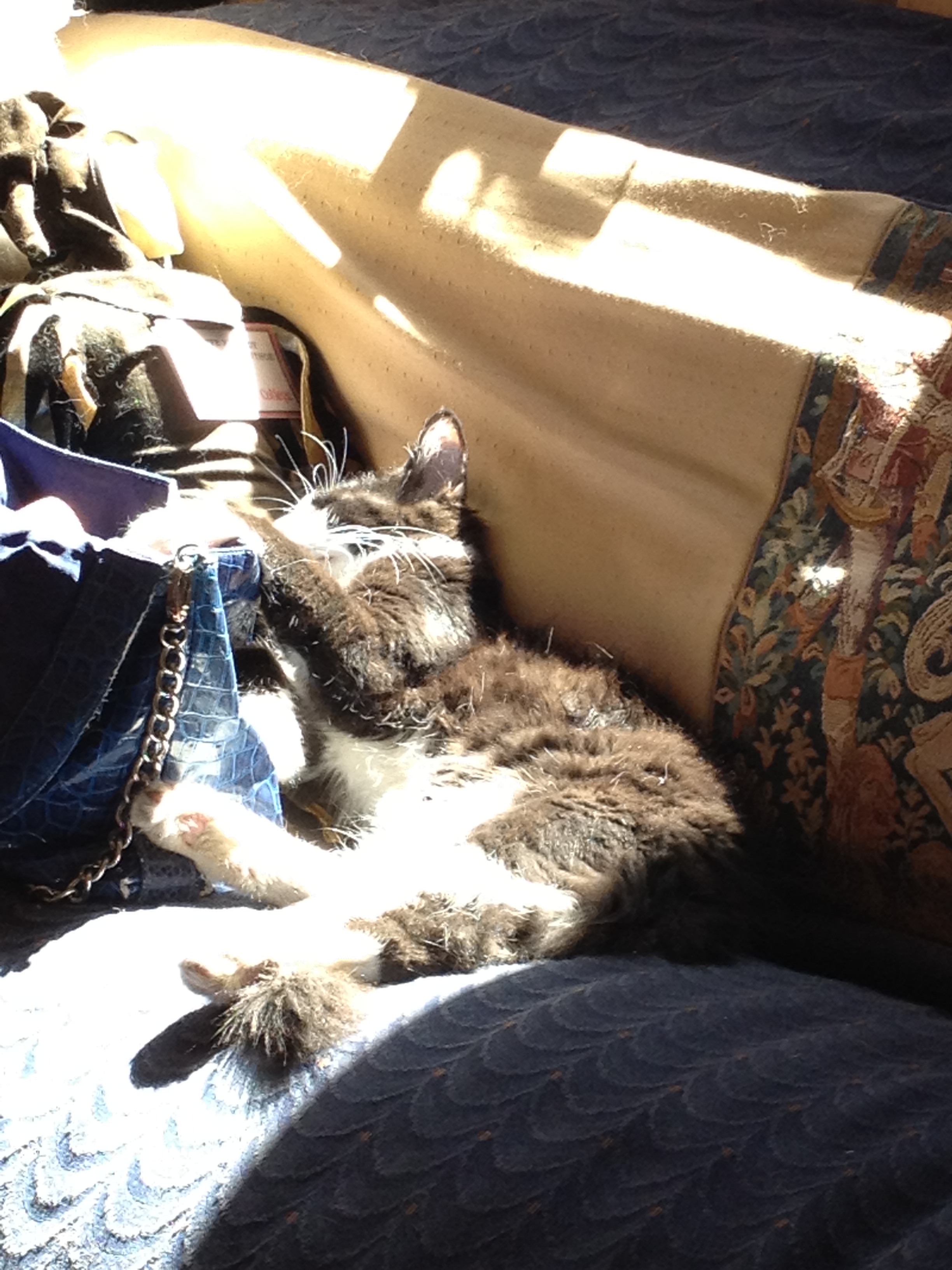
Jackson was playing in my purse and fell asleep with one incriminating paw still inside…

The other day on Twitter – yes, where I get pretty much all of my news – I saw someone listed as an “agent and author coach.” And he was tweeting coach-y type things. You know – those energetically optimistic exhortations that you can doo eet. Usually with the caveat that you need the coach’s help to doo eet. (Sorry – Adam Sandler movies have forever corrupted this phrase for me.)

In case you haven’t picked up on my tone, I should say I’m not a huge fan of the whole coach concept to begin with.

Some of this goes back to being a 10 year-old cheerleader and having the football coaches yell at me to get the hell out of the way. And the coaches in school who also taught gym class and showed nothing but contempt for non-athletic me. So, yeah, I have issues there. But even the whole personal trainer and life coach trend bothers me. I even have a friend who’s a life coach, and she’s a really lovely, interesting and dynamic person, but I still have problems with telling people how to run their lives.

See, that’s the thing – a personal trainer or life coach really doesn’t have access to knowledge you don’t have. You can read all kinds of information on how to build muscle tone or organize your schedule. What the coach brings to the table is that outside perspective and a kind of authoritative permission/directive to do the things you really want or need to do.

Fair enough.

I’m stubborn and self-directed, sometimes to a fault, and I really don’t like other people telling me what to do. Not my gig.

But let’s talk about these “author coaches.” We all know that the job of agent is in flux. With the rise of digital publishing, authors have access to publishing again in a way that they didn’t for many years. We still need agents to reach the upper echelons of traditional publishing, but that particular brass ring isn’t quite as shiny as it was. Certainly it’s not the be-all and end-all of a writing career anymore. Advances – where agents traditionally made most of their money – have shrunk or, in the case of many digital publishers, have gone away.

A lot of writers are questioning whether they need an agent. When I see agents selling their clients’ books to the exact same digital publishers that I am, I wonder, too. That debate is another issue, but what is undeniable is that many agents are reinventing themselves and their profession. Clearly the agents selling clients’ books to digital publishers that don’t do advances are making their money through a percent of royalties, perhaps with the hope of building the clients’ readership and moving them into bigger and better contracts.

Clearly this “author coach” concept is one of the reinventions. This feels predatory to me. An agent’s job is to be your advocate, get you access and know the contract negotiations. Not to be your friend and cheerleader. I know some authors have this relationship with their agent, which is great, but it’s not necessary. What is necessary is that they have information and expertise that you don’t have. And can’t just read up on.
 
I think that’s what it comes down to for me: anyone can call themselves an author coach. Hell, every time I tell my CPs they can doo eet, I’m being an author coach, right? Does this entitle me to a percentage of their royalties?
 
Hmm….

Does a Book Deal = Happily Ever After?

Everyone likes a happy ending. Even the people who think the traditional Happily Ever After (or HEA as the romance-world calls it) is trite, still love it when the hero or heroine triumphs, when good defeats evil, when they finally blow up the Death Star.

It’s just human nature.

It’s also tempting for writers to view signing with an agent or getting that Book Deal as the HEA. After all, we labor for years, querying to silence, receiving rejections, going back to the drawing board and trying again. When someone signs with an agent, there is much cause for celebration. When Carina offered to buy my novel, I confess I cried tears of relief and joy. The moment was a culmination of so much effort. But is it really a happily ever after?

Those of us familiar with romance tropes know that, for a very long time, every romance novel culminated either with an engagement or a wedding. The exception to this was the Marriage of Convenience story, where the wedding takes place early on, emotional obstacles must be overcome and the story resolves with declarations of true love. However, that’s still usually very early on in the marriage. This kind of thinking was largely a product of the times. Happiness was found in commitment, which meant marriage. Now there’s more flexibility. Finding love is enough. Many romance books end in very satisfying HFNs – Happy for Now. As society has discovered: marriage isn’t necessarily the answer.

The other problem with this trope of ending with the wedding is, though we all loved the idea that they’d ride off into the sunset and lead deliriously perfect lives, we all also know that the wedding is really just the beginning of the story.

It’s the first step on a long, often difficult, road that you’ll walk the rest of your life, if you’re lucky.

You see where I’m going with this.

Signing with that agent or getting that Book Deal is just the beginning. Basically you’ve gotten the job you applied for. Someone is willing to invest in you being a Writer. Hooray! Now the real work begins. And not the glamorous honeymoon stuff, either. It’s the dividing the chores and staying up all night to soothe the colicky baby. It’s the fighting over money and in-laws and the temperature of the bedroom. It’s worrying that maybe you’re not as attractive as you used to be and wondering about that sexy new assistant. It’s about dealing with health issues, tax audits and job layoffs.

It’s not that marriage is always about the difficulties. But it’s not skipping down the beach hand-in-hand, either. (Except maybe on vacation.)

Having a writing career is like having any career. There’s the day to day work, the highs and lows. The struggles and the moments of sweet triumph.

So celebrate that book deal. Enjoy the validation of an agent representing you.

Just remember that, after the honeymoon, that’s when the story really begins.

Being Smart

Part of the cliffside at Bandelier, the cliff dwellings I talked about yesterday.

It occurs to me that a place that’s great for carving out caves also boast it’s fair share of cracks and holes.

A few years back, I was offered the opportunity to sign with a literary agency. Kinda sorta. The agent emailed me, enthused about my manuscript and set up a time to talk on the phone. She missed that appointment and set up second time. We talked then, but things were crazy for her and she couldn’t talk long. She liked the book, but wanted me to revise. The pacing needed work, she said, and a few other things. She’d send me detailed notes on it. If I fixed those things, she had the perfect editor in mind.

I never heard from her again.

Now, I would have been pleased to revise, given something more than the vague ideas she flung out on the phone. But, the agency was very new, she was even newer, seemed kind of flakey and I could see that the agency had only ever sold to one editor at one publishing house and that particular editor had already rejected the manuscript. Now, it’s possible that could have been overcome with revision, but I never even got to have that conversation with this gal. I had a bad feeling about it all, so when she didn’t send me the promised notes, I never pursued it. Not long after that, she left the agency.

At that time I was pretty new to the fiction-publishing world. But I have been out in the business world long enough to have a pretty good idea of professional behavior. I don’t know about all of you, but my day job company makes sure we understand our business model. We have to know the requirements of our contracts and the ins and outs like conflict of interest and quality assurance. I know that if somebody tells me a deal is predicated on me making some changes based on notes they’ll send that they never do, then it was never a good deal to begin with.

This is common sense.

When we sign with our agents, we place a tremendous level of trust in that relationship. We trust that they will act in our best interests. However, much as in marriage, hopefully you place that trust based on good information in the first place and then you remember that trust doesn’t mean having your brains sucked out of your ears.

The thing to remember is that, while an agency should be acting in their authors’ best interests, they have their own interests at heart, too. Hopefully those two things coincide. Sometimes, though, a brilliant plan for short-term gain is not the best strategy for an author’s long-term career. Guess which part each player here might care about most?

Even if you have an agent, authors, there  is still no one who will care about your career more than you do.

Be smart.

A Reason to Say No

I’ve started querying agents again.

I know, I know. I said I didn’t think I wanted to. I still don’t think I want to.

But I want to give The Body Gift the best possible chances. So here I go again, go again. (Yes, I’m totally feeling like OK Go on the treadmills.)

So, you all know how it goes. The queries go out. Vast silence ensues. People are reading. Be very, very quiet so they can concentrate.

But, every once-in-a-while I get the insta-reject. Or near instant – within a few hours. I know these are from the readers whose mission it is to say no. They scan the incoming queries and hit the “no” button as soon as they find a reason to. This is how the business works and I totally understand that.

Still, it reminds me of an NYC editor friend. She was a friend of a friend, who came to visit, so I spent some social time with her. She published mainly celebrity tell-alls and kitschy coffee-table books. Once of her favorite rhetorics was “Give me a reason to say no.” Getting a book through all the layers of approval at her mighty publishing house was such an Olympian feat that, if she could at any point find a reason to say no to a project, she would.

I sometimes imagine how it would be if we all approached dating this way. The human race would die out.

But that’s neither here nor there. This is the cutthroat business of Big 6 Publishing.

It got me thinking though, because Jane at Dear Author, a blog I really admire for its forthright honesty, posted the other day about how agents are the unseen gatekeepers to reading. She referring to a daunting story where two successful authors collaborating on a project were told by a major agent that he/she would represent the book if they changed a gay character to straight, or cut him altogether. There was much wailing and gnashing of teeth over this because, thankfully, this sort of thing is just not acceptable to say anymore. At least in certain circles. That’s not to say that this sort of thing hasn’t been going on all along. Jane’s point, and I think it’s a really good one, is that most readers didn’t know it.

Why would an agent suggest such a thing? Right. It’s a reason to say no.

The agent is thinking ahead to the ladder of editors, the marketing folks, the distributors, the booksellers and imagining if anyone in that whole vast chain would say eek, we can’t sell a gay main character.

Not hard to imagine at all.

Maybe the dating analogy is relevant, after all. Agents like to say that they only represent projects that they fall in love with. To some extent I imagine that’s true. But I think it’s more to the point to say that they want projects they think other people will fall in love with. So it’s not so much if their date has a bad habit of slurping his soup or blowing his nose on the napkin, it’s more, will everyone fall in love with that strong jaw and those steely blue eyes.

The agent figures she’ll just keep him away from restaurants until the ring is on his finger.

Waiting for Godot

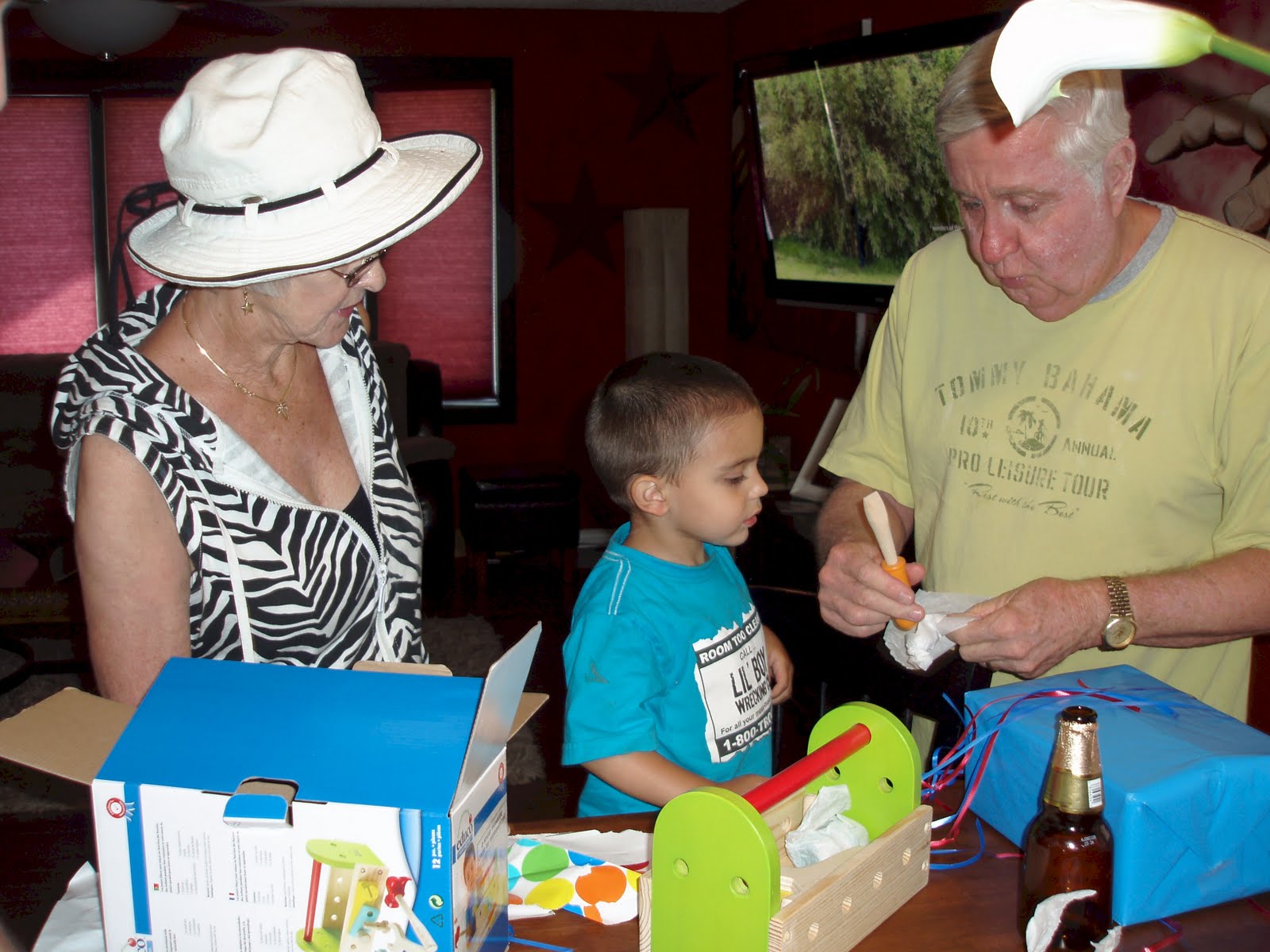
Here’s a pic of grandson Tobiah with my mom and Stepdad Dave, who is helping Tobiah open his birthday presents. A little catch-up here, since I posted a pic of granddaughter Aerro last week.

So, I was at a bit of a loss on what to write about this morning. It’s kind of that tip-of-the-tongue feeling, like I had a topic in mind, but can’t quite recall what it was. Tomorrow is all about Feeding the Vampire’s book birthday. But I had *thought* I had a plan for today.

Then I remembered.

Oh yeah, I totally thought I’d talk about my agent and my new book deal today.

But you know what? She promised to get back to me by Monday (yesterday) and she hasn’t. Everyone keeps telling me to give her more time, but it’s been officially one week now. I’m not necessarily in a hurry. Still, I don’t see much reason to sit on my hands any longer. Publishing is absolutely about patience panties and waiting for people to get back to you. When the ball is in my court, however, I don’t see much reason to wait.

It was kind of amazing, really, how people popped out of the woodwork with advice when I announced that I had a contract offer. Everyone was full of the advice to contact every agent I’ve ever kibbitzed with and let them know I have an offer on the table. This is the moment, they urge me, to hook an agent.

I feel vaguely like the girl who’s gotten pregnant and is looking to bag her man with it.

The thing is, like that knocked-up girl, I’m feeling a bit like, if they didn’t want me for myself and my work before, then I’m not sure I want them just because I’ve got a bun in the oven. Frankly, I’m not convinced I want an agent at all. Kristine Rusch, who posts the very insightful Rusch Reports on the publishing business from the writer’s point of view, recently laid out really good reasons why unagented writers not sign with agents. (The post contains a fascinating history of how literary agents came to be in the first place – well worth reading.)

Her post came at just the right time for me, because she echoed what I’ve been thinking, from all the reading I do about the huge changes in publishing.

Now, I’m not so concerned about the agency clause. The gal I’ve been talking to has a boutique agency, so I imagine she doesn’t have anything really bearish like that. But, more and more, I’m wondering what agents can do for writers that we can’t do for ourselves. A bunch of agencies are now announcing that they’re assisting their authors with self-publishing, or even developing epublishing branches. They’re clearly doing this because their traditional revenue streams are drying up. Indeed, several of my friends who have long-standing relationships with agents are not seeing new sales to publishers right now. Except maybe in Young Adult.

It’s a difficult time for agents. I totally get that.

So, right now I’m not convinced having an agent would really make a huge difference for me.

I’m still the awkward girl at the prom. My work is still the kind that the big publishers frown at, with worry on their faces, unable to clearly envision where they’d put me on the bookshelf. I truly believe the key for me lies in building readership. (Thank you, all you lovely readers who read and say nice things to me!) People out there do want to read my books, but no one will know it until I have some numbers.

I’m at peace with that.

What I’m not at peace with is waiting. I don’t want to be like Vladimir and Estragon, eternally distracting myself while I wait for something I might not even recognize when it arrives.

No point in reaching for that brass ring if they’re dismantling the Carousel and converting it into the Zooming Horses Racetrack.

(Wouldn’t that be a cool ride?)

So: no announcement today. See? Here you are, waiting along with me. I may yet sign with this agent or another, on a future project.

But, on this, I’m ready to move forward.

Let’s do this thing!

Agency Publishing and Conflict of Interest

Bows and flows of angel hair and ice cream castles in the air. And feather canyons everywhere.

For those of you old enough to remember this song, you’re welcome for the ear worm. You know, aren’t we due for a really good cover of Both Sides Now? Someone should really get on that.

So, it’s been an interesting week in the publishing world, vis a vis agents and electronic publishing.

On Monday, much-sought agent Jessica Faust announced on the Bookends, LLC blog, that the literary agency would be developing an epublishing arm. At the time I’m writing this, there are 152 comments on the post. See, they’re not the first agency to announce that they’re partnering with their authors to assist them with self-publishing their backlists. Bookends, however, is taking this one step farther and plans to establish an entire epublishing arm, which would involve them screening submissions, editing books, electronically publishing them and marketing. For this, Bookends would receive an unspecified split of the revenue.

This is a huge move, from agenting to publishing.

Yesterday, Courtney Milan, romance author and lawyer, posted an excellent breakdown of the situation in An Open Letter to Agents. Now, she does not specifically address any agency in particular – I’m the one drawing this correlation. Courtney lays out the situation in a clear and logical way. She promises a second part today, which I’m interested to see.

What it comes down to for me is Conflict of Interest (COI). Now – full disclosure – COI is a fairly large part of my day to day considerations. I work for a private environmental consulting firm, funded largely by government contracts, primarily EPA. We have meetings about COI fairly often, because we owe it to our clients to do so.

For example (and you can totally skip this part if it’s too boring), a company that analyzes water samples contacted us. They’ve developed a database system for wastewater plants that processes the results of their water tests, compares the data to EPA’s regulations and tells the plant operator where they are in compliance with the law. This company would like to develop something similar for drinking water. They came to us, because we’re the drinking water experts. All fabulous, right?

Well, no. Because one of the things we do for EPA is assess water system data and their determinations about whether they are in compliance with the law. I’m essentially an auditor. So, if I were to help design a program to determine compliance, while I’m also assessing how well a system using that program does it, then I have the appearance of a COI. Because I could skew the results in my favor.

Now, I would never do that. I’m an objective scientist with strong personal and professional ethics. None of that matters – our company could lose multi-million dollar contracts if there’s any chance of COI. Because my client, EPA, awarded me this contract to be their agent and no one else’s.

We had several meetings on this issue and eventually decided any role we’d play would have to be one step back. I can explain the federal regulations and the nitty-gritty of compliance to the program developers, but how they set it up is up to them.

So, let’s look at a literary agent publishing her clients’ work. A writer engages a literary agent to represent her work to publishers. The agent has the contacts, the sales experience and the business savvy to get her client the very best possible deal. The agent represents the writers’ interests.

If the agent becomes a publisher, she now has an interest on the other side of the fence. To my mind, this is more than even just the appearance of COI. Arguably, agents who are also writers have this same conflict. Breezily declaring that, oh they have no COI and, besides, they have integrity simply means nothing at all.

In fact, that some agents fob off COI as irrelevant says to me that they haven’t seriously considered the issue.

I’d believe that. It might be that you only really think about these things when you have to go through three meetings investigating all the possible COI ripples for each new project, that it becomes a serious consideration.

The thing is, it’s only a consideration for them if it becomes a problem in their contract with their clients: the authors. Just like I would be in trouble if I violated my contract with my client, EPA, an agent would be in trouble for violating the terms of their contract with their client, the author, only if the author came down on them. Now, EPA and the federal contracts office can come down on us like Armageddon. Will an author come down on her agent in the same way?

I think we all know the answer to that.

I venture that this is why literary agents aren’t terribly concerned about COI. There’s really no reason for them to be. The only people hurt by any COI on their part is the writers.

It remains to be seen whether we’ll do anything about it.

Label Me

I’ve discovered I’m really bad at labels.

You know, like choosing labels for the blog posts. Like on yesterday’s post, I wanted some kind of label that would reference the way I fret over the animals, the small and the weak. I know it’s one of my themes that I revisit, but how do I summarize that in a word or two? That’s why I write the meandering story about the several things coming together. It doesn’t quite gel into a word or two for me.

I mean, scroll down and look at my label list at the bottom of the blog (you don’t have to – it’s a mess). I have hundreds of labels, I’m sure. So much so that I suspect it’s worthless to try to find anything through my labels. Hell, I can’t find what I’m looking for in that enormous label cloud.

I even created a spreadsheet now (you know how I love my spreadsheets) where I put in each post, which photo I use and the labels. Theoretically this should organize me. I’ve tried imposing a moratorium on creating new labels, to try to force myself to stay within the 972 I already created. (No, that’s not an accurate number – I guessed. I’m not counting them.)

Oh, and look, I created a new label today: labels.

It’s like a sickness.

I think of this when I see agents make scathing remarks about how they don’t understand how authors can possibly not know what genre they’re writing. Now, we all know agents specialize in scathing remarks. It’s pretty much a tool of the trade. But it always makes me want to stomp my little foot and whine that it’s really hard.

No, Tawna, I mean difficult.

I totally get why categorizing by genre is important. As a reader, I look for sections in the bookstore. The marketers need to know how to telegraph the story’s promise. Agents use it to target particular editors. I understand that there are genre conventions that establish the contract between the writer and the reader. All of that makes perfect sense.

But ask me to identify genre for a story and I fall apart.

It’s not just my stories, either. I’ve practiced and worked at identifying what genre a book or movie falls into. It rarely clicks for me. It’s like trying to describe a person in one or two words. He’s a Western guy. She’s a New Yorker.

The storyteller in me always wants to take it a few steps farther. He wears a King Ropes ballcap, stopped hunting years ago and carries a dog-eared copy of Napoleon Hill in his pocket. She’d leave New York, even with all its promises of glittering success, if it wouldn’t seem like such a concession to everyone who said the city crushed girls like her.

I suspect what makes a good agent is the ability to condense a story to its key element and target the right market. What makes a good writer is the ability to spin a story, an entire world or universe of people, from something minute.

It’s the difference between deductive and inductive reasoning. Not all of us are good at both.

Dammit, I just created another label.

Uncool Beans

I thought my neighbor’s tree looked really neat in this light, with the storm advancing behind it.

I’d like to offer a shout-out this morning to Abby Mumford, who is a sometime commenter and frequent pimper of this blog. She passed along the Stylish Blogger Award. It’s a lovely thing, to have someone recommend your work to others. I don’t much like to play the blog badge game, because it reminds me uncomfortably of chain letters. And I’m old enough to remember when chain letters actually came in the mail. Which arrived on exhausted ponies. In ten-foot deep snow.

At any rate, I won’t post you a list of my secrets, because I pretty much spill everything here anyway. But thank you, Abby – I greatly appreciate the nod!

Last night David commented that the waitress in the movie we watched didn’t look old enough to serve drinks, and that it was the second time we’d seen that in a movie lately. I said, either that, or we’re just getting old enough that they look really young to us now. It’s an interesting thing about age-perspective. The people around your own age look “right” and everyone else is lumped into older or younger.

The other day I saw conversation between two twenty-something agents on Twitter. A lot of publishing professionals – especially the ones really using social media – are twenty-somethings. They’re fresh out of college, interning and starting at the bottom level. They make terrific agents because they don’t have extensive client lists yet and they’re full of energy and enthusiasm. Both of these gals rep Young Adult books, so their own perspective is arguably much closer to that of the readers than an older person’s would be.

One said that she feels awkward correcting outdated slang in manuscripts.

The other said, Oh, I know, right? I just took out “cool beans” from a manuscript.

And all I heard was Mom! You’re embarrassing me!

Okay, sure – we all retain an unnatural attachment to the slang of our youth. It dates us, as surely as mentions of paper chain-mail letters and stories where the girl actually had to stay at home when she waited for a phone call from a boy. The words and phrases that make us superbad as teens render us hopelessly square twenty years later.

(I’d like to insert here, however, that “cool beans” was never a serious slang term. Hint: if the Urban Dictionary’s main citation for a term is Cheech & Chong, it was never more than tongue in cheek. We didn’t really smoke Labrador, either. Erm, most of us, anyway. The fact that it was picked up and used as a running joke in Full House, well, I can’t help that.)

These gals are doing their jobs, updating the language for today’s savvy youth. However, it’s worth keeping in mind that what’s hip today is lining bird cages tomorrow.

(How many old slang terms can I trot out in one post? This is more fun than a barrel full of monkeys!)

It’s kind of like fashion: beware the fads. Go for the classics. That black jersey knit skirt can last decades with proper care and always looks in style. Those black rubber Madonna-wannabe bracelets? The hot pink half-shirt that says RELAX in neon green? Not so much.

I suspect the answer is to avoid slang as much as possible. I don’t write YA, so I don’t labor with trying to sound nifty keen to the youth of today. The classic curse words though? They’ve been around, doing their dirty work for centuries now. Serious staying power there.

Besides, you don’t want to embarrass your agent.

Chain letters? Weren’t those invented with email?